Showing posts with label Learning. Show all posts

Sunday, 29 March 2015

On learning a foreign language (Part 2)

It's been a year and a half now since I last wrote about learning a foreign language.  A lot has changed since then.  I'm starting to get the hang of this German business now, and for the most part I get by.  I'm certainly nowhere close to being fluent, but somehow I am managing to function every day auf Deutsch.

Of course, it does help that I finally sucked it up and hit the books.  Last spring I signed up for an intensive B1 course at the Volkshochschule in Cologne.  (For those of you not in the know, the Volkshochschule is a German institute for adult education: a much more affordable route for learning German than Berlitz or the Goethe Institute, although you won't get any official accreditation).  The course gave my German skills a major boost.  The biggest difference I noticed was my grammar.  Before taking the course I would often just throw random words together into a sentence, and pray it made some kind of sense.  Now I'm much more conscious of things like cases and word order.  The rules haven't yet become automatic, but at least now I think about them and try to correct myself.

I have progressed.  Really, I have.  And people are noticing.  But no matter how good my German gets, it never feels real.  The truth is, most days I feel like a big fat fraud.  It's like I'm putting on an act for everyone.  I don't really speak German – I'm just playing the role of someone who does.  I'm constantly acting, pretending, struggling to "pass" – and hoping that people won't see right through me.

There are days I'm so sure that someone will turn around and call my bluff.  "YOU don’t belong here!" they'll say.  "You don't REALLY speak German!"

"RAUS, du Lügner!!!"

I always knew learning a new language would be an intellectual challenge.  What I wasn't prepared for was the emotional challenge.  The feeling that you never really fit in, and you never really know what's going on.  The frustration that comes with being unable to express yourself fully or accurately.  The intense homesickness of missing your native language.  The loneliness and isolation that comes with realising you're the only person in the room who speaks it.

All of the feels.

When I first moved to Germany, I used to play it safe.  Surround myself with English speakers, and only speak German when it was absolutely necessary.  It was like I had this safe little English bubble to float around in.

Lalalala.... bubbling around...

But I couldn't stay in this bubble forever.  After all, I wouldn't always have English-speaking colleagues around.  More and more, I began to find myself in situations where nobody else spoke English.  It was overwhelming, and it scared me half to death.  But it left me with no choice.  I had to sink or swim.  If I wanted to survive, I would have to do it auf Deutsch.

How can I explain the discomfort of constantly speaking a language which isn't your own?  It's like an extra layer of challenge has been added to every single part of your day.  Imagine if you could never see things clearly, but instead had to peer through a screen all the time.  You never get a full picture of reality.  You're always squinting and craning your neck, trying to piece together what on earth is going on from what you can – just barely – see.  That's what it feels like speaking German every day.  Some days the screen obscures a lot, and sometimes it's more transparent.  But make no mistake, the screen is always there.

"It looks like... they're saying something.. about..... a bicycle?"

Perhaps the most difficult thing is that, in German, I can't really be myself.  I'm far too self-conscious and slow on the uptake.  I must seem like the most boring person in the world in German.  I hardly say a word aside from "ja" or "stimmt".  Usually by the time I've understood someone and formulated a response, they've moved on to another subject entirely.

One-on-one conversations are fine, because my conversation partner can always slow to my pace.  But group situations are the absolute worst.  As the talk gets lively, everyone starts talking a mile a minute and interrupting each other.  Meanwhile I'm sitting in silence, looking for all the world like a dull and humourless idiot.  It probably seems like I have no thoughts or ideas in my head at all.  The truth is that my head couldn't be busier!  While everyone else is nattering on, I'm making a bunch of complicated linguistic calculations and mental back-flips just to get a basic grasp of what they're talking about.

So much.... translating....

Any friend of mine can attest to the instant transformation I undergo when I switch from German to English.  As I move to my native tongue, all hesitations fall away, and my true self emerges.  One minute I'm dull as dishwater, and the next minute I'm the life of the party.  Hey, who knew it?  Turns out this girl actually has a personality!

For this reason, I still socialise a lot in English.  Most of my friends are other native English speakers, or Germans with very good English (there's a lot of those).  I may be able to make small talk and friendly chat in German, but this always comes with a certain level of awkwardness, and a lingering feeling that I'm doing my math homework.  It's one thing to go through this effort when I'm on the clock, but why would I want it in my down-time?  Only in English can I truly relax.  Only in English can I feel natural, and be myself without worrying about whether I just used the right pronoun.

"Ahhhh.... this is the life."

And so a real dichotomy has developed.  German is my work language, and English is my leisure language.  It's like I put on a German hat to go to work, and take it off as soon as I get home.

I often wonder when this language will become second nature.  When will I be truly fluent?  When will I speak German with bravado and ease?  When will I form a sentence without thinking, is it der, die, or das?

Years later, Joe still wonders if it was "die Birne" after all

One sure sign will be the day I have a real German friend.  I'm not talking about a German friend who speaks English with me.  I'm not talking about a friend-ly German, who speaks simple German with me so we can make superficial chitchat.  I'm talking about a German who speaks to me in German consistently, using sophisticated language, and discusses deep and important issues.  I'm talking about someone who can be real with me in their language, and not have to constantly worry about dumbing things down.  If I can reach that level of understanding with a native German speaker, I'll know I've really made it.

But I have to be patient.  Learning another language is a slow process, and nobody becomes fluent overnight.  It takes years of repetition, immersion, and trial and error.  Sometimes your progress can be so slow it's imperceptible – and other times you'll make a huge leap and completely surprise yourself.  It will be years before I can feel completely comfortable in German.  In the meantime I'll have to be kind to myself, and trust that I'm moving forward.

Friday, 12 December 2014

Tips for Freelancing (Part 3)

Welcome to my third post of freelancing tips!  These are mostly things which I've learned the hard way, "on the job".  I'm posting them here in the hopes that some of you can avoid making the same mistakes.  At the very least, you can enjoy chuckling over my blunders with a mixture of recognition and Schadenfreude.  If you've missed my past posts, you can find Part 1 here and Part 2 here.

21. Be prepared.
This is one point I have to say I've never struggled with.  I have always been very conscientious about learning my music.  But unfortunately I can't say the same for all of my colleagues.  I have seen people show up at the first rehearsal not knowing a single note of the score.  And it is REALLY annoying.  Any musical endeavour is only as good as its weakest link.  And when someone doesn't know their music, everyone else has to slow down their progress to accommodate them.  This is an extremely unfair burden to place on your colleagues.  Not only is it unprofessional, but it shows a complete lack of consideration and respect for others.  And don't think that your colleagues are the only one who will notice you don't know what you're doing.  The director, the conductor, and any other management present at rehearsals will certainly take note.  You can be sure that no matter how talented you are, they won't want to hire you again.

Scar makes a good point.

22. Dress the part.
I'll never forget my first Messiah.  It was at a cathedral in Paisley.  I wore a beautiful sleeveless sapphire-blue evening gown.  And I almost froze my tits off!  If I had put any thought into my attire (aside from the vanity of wanting to wear a pretty frock) I would have remembered that the Scottish winter is pretty cold, and most churches don't use central heating.  I would have worn thick woolen tights, and a dress with sleeves.  At the very least I would have covered my shoulders with a jacket or a shawl.
Any time you are performing at a new venue, or with a new company, make sure you do your research on what to wear.  Do they have a dress code?  How conservative is the audience?  Are bare shoulders and cleavage frowned upon?  Are women allowed to wear trousers?  And most importantly, how hot or cold are you going to be on stage?  It is essential to dress appropriately if you want to avoid being embarrassed or uncomfortable.

23. Make sure you're on the same page.
Here's another fun anecdote, again from Scotland.  I was hired for my first Vivaldi Gloria.  I immediately got a score from the library, and began preparing my part.  On the day of the concert I made a horrifying discovery: there are two versions of the Vivaldi Gloria, and I had prepared the wrong one.  The edition I had prepared had a considerably shortened version of the duet with the soprano.  We were performing the longer version, and there was a big chunk of music which I had never seen before!  After some panicked photocopying and note-bashing, I managed to get through the concert without disaster.  Needless to say, though, it was not ideal.  This is how I learned I had to check exactly which edition to use.  Don't make the same mistake I did!

24. Check, double-check, and check again.


To Do:
-Make List
-Check Twice

Make sure you're absolutely certain about every last detail.  The repertoire, the fee, the timing of the rehearsals, the address of the venue – anything which risks getting confused or miscommunicated.  Be meticulous about this, and do it well in advance of the gig.  Read and reread any information you've been given.  Make sure there's nothing missing, and if there is something missing, ask.  There is nothing more embarrassing than showing up at the wrong place, or at the wrong time.  There is nothing more uncomfortable than having a misunderstanding with your management about scheduling or money.  So make sure you know everything and are ok with it.  This is what contracts are for.  Which brings us to…

25. Dot your i’s and cross your t’s.
I know, I know.  Paperwork sucks.

"Um... a little help..?"

But most of the time it's there for your sake.  And if you don't pay close attention to it, you could land yourself in deep trouble.  Like any job, freelancing involves important financial and legal considerations.  So get your reading glasses out and protect yourself.  Make sure you're registered for taxes as self-employed.  Educate yourself on which expenses you can claim, and how to prepare and file a tax return.  Get insurance, and if you can, a savings plan.  In Germany we have a wonderful thing called the Künstlersozialkasse (how's that for a mouthful?).  You make monthly payments based on how much you're earning, and in return they pay your health insurance and put money into a pension plan.  This is an invaluable resource for any freelancing musician.  Most importantly, pay careful attention to the paperwork your employers send you.  Any time you get a contract, make sure you understand and agree with everything before signing it.  Remember: you're usually the only one looking out for yourself.

26. You don't have to like everyone, and not everyone has to like you.
This is a hard enough lesson to learn in life, but it's especially painful to acknowledge when it comes to music.  I know we all like to think that music-making is a magical process, and everyone involved is brought together in peace and loving harmony by the beautiful sounds they make.

"Kumbaya my Lord, Kumbaya...."

Let's get real though.  Music attracts all kinds of personalities, including the difficult and unpleasant ones.  Don't get me wrong here.  I hope the majority of your employers and colleagues will be lovely, kind, and friendly people.  I hope you will have lots of things in common, and enjoy each other's company.  But the fact is, not everyone is going to become your new bestie.  In fact, some people might be downright mean to you.  The sooner you learn to accept and cope with this, the better.

27. …But you do have to get along.
You don't have to have go for chummy beers together after rehearsal, but you do have to be civil to each other.  No matter what you might think of someone personally, at the end of the day they still are your colleague.  You have to be able to work with them in a pleasant and respectful way.  And this may not be the last time you work with them.  So stay on good terms.  Don't burn any bridges.

28. Learn to manage your diary.
As a freelancer, your diary can look pretty crazy – especially in December.

What the Christmas season looks like for most of us.

But until you get your own management or can afford a personal assistant (sure, that'll be the day) managing your diary is up to you.  Before you accept another gig, take a good long look at your calendar.  Are you sure you're not double-booking yourself?  Are you sure you're not taking too much on?  Think twice before accepting new commitments.  As for the time between gigs, that's important to manage too.  You'll likely have a long to-do list and a lot of unstructured time in which to tackle it.  Learn to prioritise.  What's urgent?  What's important?  What can wait a bit?  Pay attention to your energy at different points of the day, and try to schedule your work accordingly.  Ideally you would want to do your practising when you're feeling the most energetic and focused. You can save your paperwork and emails for when you're feeling more mellow.

29. Know Yourself
Everyone is always talking about how you have to "sell yourself" in this business.  But how can you sell yourself if you don't know what it is you're selling?  Before you start "getting yourself out there" – auditioning, building a website, networking with prospective employers and so forth – you have to do some soul-searching and answer a few important questions.  What are your unique talents and skills?  What kind of musical and performing personality do you have?  What kind of repertoire suits you best and why?  What kind of work do you want to do?  Your answers to these questions will inform a lot of decisions, such as how you market yourself and who you audition for.  It will also help you feel more focused and confident as you continue to build a career.

30. Add some strings to your bow.
Very few musicians make a living doing just one thing.  It's tough out there, and work is hard to come by.  So if you are going around looking only for work as a concert pianist, you are narrowing your possibilities considerably.  How about being a concert pianist who also accompanies, teaches private lessons, and composes arrangements for their own ensemble?  Now we're talking.  Everyone has their own variety of skills and talents.  So find out what else you can do well, and capitalise on that!  The more diverse your skills, the better your chances of survival.


The most important thing to remember?  Freelancing is a tough business.  And despite all the anecdotes and tips I've tried to share with you on here, you will probably make your own unique set of mistakes.  Don't sweat it too much.  Mistakes are normal.  Just make sure you learn your lesson and move on!

Tuesday, 26 August 2014

Lucerne Festival - Week 3

Our third week in Lucerne has been nothing short of unforgettable.

We began the week by moving into the concert venue, and meeting our new friends in the orchestra.  On Monday we watched as they did a read-through of the piece, and put us all to shame.  I can't imagine the choir being able to hold the piece together so well on our first day.  We had a full week of sectionals before we even sang together as a full choir!  We were all very impressed by the orchestra, and excited to join them for the first tutti rehearsal.

The Culture and Congress Centre Lucerne, or KKL - home to the Lucerne Festival.

Next it was time for us all to meet our instrument "siblings".  Instead of sitting separately from the orchestra as usual, in Coro the choir sits in the orchestra.  Every singer is paired with an instrument, or "spirit animal" as my friend liked to call it.  This instrument plays alongside you for the whole piece, sometimes in unison, and sometimes embellishing or harmonising with your part.  I was paired with a clarinet, as was my neighbour.  It was somewhat disorienting to go from singing in a choir to sitting in the middle of the orchestra.  I was used to hearing the other altos.  Suddenly all I could hear around me were clarinets and alto saxophone!

Actually, most of the time the orchestra made things much easier for us.  Our instrumental siblings' parts were cleverly written, so that they would often give us our notes.  No more trying to pluck random pitches from thin air!  My tuning fork wasn't such a desperate necessity anymore – still, I liked having it around at all times.  It was something like a security blanket, lying by my side just in case.

"It's ok.  Tuney will keep me safe."

Then again, there were also passages where the orchestra was playing completely different rhythms or notes from the choir.  At times like this you had to be extremely confident with your part –  watch the conductor like a hawk, and just keep plowing ahead.

Speaking of conductors, we were lucky enough to have a great captain at the helm of our crazy ship.  Sir Simon Rattle always kept the rehearsals fun and full of entertainment.  We were all surprised by how human he was.  Despite his fame, he was no diva conductor in an ivory tower.  He was an extremely charming and personable man, and eminently quotable.  We all enjoyed sharing his little quips over facebook and twitter.  In fact if you look up the hashtag "sirsimonsays" you might find a few gems which we heard from him this week.

Sir Rattle made sure that we did a run-through of the piece in each rehearsal.  At first I didn't understand the point of this – surely it wasted a lot of time we should be spending on fixing mistakes and going over the tricky bits?  But after a while I began to see the value of these run-throughs.  Each time we did the whole piece in one go, it held closer together as a whole.  We became familiar with the piece's rhythm and shape.  We knew how each part flowed into the next.  When we had to be on tenterhooks for the next movement, and when we could look forward to a well-earned rest.  With each run-through, we gained a bit of confidence, and the final performance became a bit less daunting.

When you're singing for such a prominent conductor, you tend to take every little thing he says to heart.  One time the Maestro critiqued my English diction, and I was beating myself up about it all day.  Another time I was singing a folky French solo, and he wanted it to sound more dirty.  "You sound like you washed this morning," he said, "and we don’t want that."  I seriously considered not showering for a week, just to please him.  Then again, I don't think my colleagues would have appreciated that.

"WHAT??!  I'm doing this for the sake of art!!"

Between rehearsals, we had the privilege of attending some amazing concerts with world class artists.  Now that the festival had begun in earnest, we regularly had opportunities to hear artists such as Midori or Lang Lang performing live.  Evenings often saw us lining up for last-minute discount tickets, as we tried to soak up as much of the festival as we could.

Before we knew it, the final performance was upon us.  We prepared a free lecture concert, a sort of "aperitif" for anyone interested in hearing the full piece the following day.  The hall filled up very quickly with curious concertgoers.  Some people even had to be turned away at the door.  Sir Rattle spoke to the audience with ease and charm.  He was particularly enamoured with the beanbag chairs in the front row, which he suggested introducing to the Berlin Phil.

BEANBAG CHAIRS FOR ALL!!!!

As the day of the performance arrived, we were all beginning to feel the pressure.  The first half of the concert would also include a world premiere by Korean composer Unsuk Chin, sung by Barbara Hannigan.  Talia Berio, musicologist and second wife of the late Luciano Berio, would be attending.  And we would have the longest list of attending press which the Festival Academy had ever seen.  Coro is a rarely performed piece which has never been heard at Lucerne Festival before.  The piece is notoriously difficult.  Everyone was curious to see how we – and of course, Simon Rattle – interpreted the music.

When we finally walked onstage in the second half of the concert, the air was electric with excitement.  We were all bundles of nervous energy.  But after so many run-throughs and rehearsals, together we felt strong and confident.  We harnessed all our adrenaline and nerves and gave our very best performance.  It was truly a magical hour.

As an encore, at Sir Rattle's suggestion, we sang Purcell’s "Hear my prayer o Lord".  It made a soulful, reflective epilogue to the concert, and contrasted starkly with Berio's intense, chaotic piece, which Rattle had described to us as a "21st century version of a Bach passion."

Finally, after all our hard work, it was time to let our hair down.  We were all invited to an afterparty at a nearby hotel with cheap (for Switzerland at least) drinks.  Even the Maestro attended, and those of us who hadn't yet had the chance queued up to get our "Simon selfie".

My Simon selfie, complete with awestruck onlooker.

It's always difficult after a project like this to say goodbye to so many lovely colleagues from around the world.  We've become very attached to each other over the past three weeks, bonding as an ensemble and as friends.  It's hard to believe that this is the end, that we'll never see each other again.  Which is why I always like to say "see you soon".  After all, the music world is so small, it's quite likely that I will.  And even if I won't, it's a comforting thought, isn't it?  Easier than thinking this is goodbye forever.

The choir has now scattered around the globe to their respective homes.  Only nine of us have stayed behind to do a week of masterclasses with Barbara Hannigan.  We miss our Coro ensemble, and the comeraderie which we shared as we tackled this crazy piece together.  A piece which once seemed so terrifying, and is now a fond memory for us all.  We may move on to new pieces, new challenges, but Berio's melodies will surely be haunting us for years to come.  

Monday, 18 August 2014

Lucerne Festival - Week 2

It's my second week in Lucerne, and – rainy weather aside – things are beginning to heat up.  The choir has now had five days of tutti rehearsals.  Which may sound like much, but actually felt like getting hit with a ton of bricks.  Although the rehearsals only lasted half the day, they were extremely intense and demanding.  What with forty different voice parts singing rhythmically challenging and not-so-tonal music, there was a lot going on.  It's hard to explain exactly how it felt to be in the middle of it all.  But I'll try anyway.

In the beginning, there was nothing for us to do but take the plunge.  So we just started singing - jumped right into the madness, and prayed to God we would come out safely on the other side.

AHHHHHH!!!!!!

Usually, in choral music, you can rely a bit on your neighbours if you get lost.  Drifted off a bit?  Not to worry.  The alto next door will set you straight.  But in Berio's Coro there is no such option.  Everyone is responsible for their own line.  If you're lost, you're lost, and there's nothing anyone can do to help you.  It's every man for himself.

So we all sat there, our faces screwed up with concentration, and desperately tried to hold everything together.  In a piece like this, simply making sure things don't fall apart can feel like a major accomplishment.  Ideally, you want to end up on the right note.  At the very least, you hope that you'll be at the right bar number.

I'm pretty sure we all look like this for most of the piece.

When you're singing this kind of music, you need some serious help getting your notes.  As I mentioned before, singers are used to reading a piano-vocal score and being able to see the full musical picture.  This is because most of us can't pick our notes out of thin air.  We need to hear our notes in our head before singing them, and for this we rely largely on relative pitch.  Normally you have a simple frame of reference for your note – perhaps it's a perfect fourth up from what the cello plays.  But in a piece like Coro, finding your note is not so easy.  There's so much going on – and most of it very dissonant – that finding your pitch can be like searching for a needle in a haystack.

Enter your new best friend: the tuning fork.

I call him "Tuney" for short.

We've all been provided with tuning forks that play an A442.  Yes, I know.  Controversial.  Most of you are probably used to A440 (or 415 for the Baroquers out there).  But I promise, it's really not a big difference.  Unless you have super-duper-uber-perfectamundo pitch, you probably won't even hear the difference.  It might feel ever so slightly higher.  But then again, does it really feel higher, or is that only because you know it's higher?

Anyway, we've all become pretty attached to our tuning forks.  If you watch a rehearsal, you can see when we're approaching a difficult passage because we all have tuning forks glued to our ears.  I'm on extremely intimate terms with my tuning fork these days.  I'm considering having it surgically implanted into my ear, to save a lot of hassle.

Tuning forks can serve multiple purposes.  I often use mine to stir my coffee.  Not because I'm being eccentric or anything.  Only because we have no spoons.  Some people worry that the heat of the coffee might affect the pitch of the tuning fork, but so far I haven't noticed a difference.

Although perhaps my coffee tastes a bit sharp.

Many of my colleagues, of course, don't struggle so much with finding notes.  There is an extremely high standard of musicianship here.  I'm used to being considered a very good musician (for a singer, at least).  But it's all relative, isn't it?  Within the context of this group, my skills are probably average at best.  My pitch is passable and my rhythm is just shy of atrocious.  I'm continually humbled by everyone else's cleverness.

Some of the singers here are incredibly passionate about new music.  I'm no new music specialist myself – at most, I dabble.  But for these guys, new music is a lifestyle, a religion, a dedicated path.  It's inspiring to see people feel so strongly about something.

It also ups the ante in the geekery stakes.  I mean, I used to think I was a real music geek.  But after hearing people wax poetic about polyrhythms and spectral-ism (still not entirely sure what that is) – I think I might actually be pretty normal.

While the rehearsals require a lot of concentration and musicianship, they're also extremely demanding vocally.  It wasn't until our first run-through that I realised just how tiring the whole piece is.  It's almost a full hour of singing, and it uses every single inch of my voice.  I have to sing in every possible way, in every part of my range.  Chest voice, head voice, vibrato, no vibrato, high notes, low notes – you name it, I sing it.  It's a real test of technique and vocal endurance.  I'm not sure which part I love to hate more.  There's the bit where I have to sustain pianissimo notes right in the middle of my passaggio.  Or there's the bit where I have to sing staccato high A's on "ee".

We call that bit "the monkey chorus".

Between rehearsals, we've had time to explore Lucerne's beautiful landscape, whether from the streets, in a paddle boat, or on top of a hill.  On an unusually sunny free day, some people chose to wake up early and climb the infamous Pilatus.  I opted instead for a lie-in, and joined some friends for a less ambitious hike later in the day.  We didn't reach the top of anything, but we met some very lovely cows.

Our hiking selfie, or "helfie".
Yes, I am wearing a sweater on my head.

In our free time we've also been hanging out with our host families, familiarising ourselves with Swiss culture.  One thing we've all noticed is that the Swiss are extremely particular.  I mean, I thought the Germans could fuss over little details.  But the Swiss bring this to a whole new level!  You probably think you know how to boil an egg, open a window, or make a cup of coffee.  Well, let me tell you something.  You've been doing it all wrong.  And somewhere out there is an old Swiss lady who's just dying to set you straight.

They also have a rather odd sense of humour.  The other day I came home, took a bottle of beer from the fridge and sat on the sofa to watch some TV.  Perfectly normal behaviour, right?  When my hosts came home and saw me, they began laughing uncontrollably.  They've been making joking references to the incident ever since.  I'm still trying to figure out what was so hilarious.  Should I have poured the beer into a glass?  Was I not supposed to drink alone?  Or did I just happen to conform perfectly with some cartoon image they had of a stereotypical "American"?  I may never know.

I say this with affection of course.  Eccentricities aside, our hosts have given us a warm welcome, and I'm more than grateful for their hospitality.

I'll just say one more thing about Swiss culture: they take their card games very seriously.  In fact there's one game which they broadcast on TV, like a football match.  Except instead of a stadium of spectators, they have an audience sitting at wooden picnic tables with bottles of wine.  Every time someone does well they shout and blow horns and thump the tables.  I'm not even joking.  This is an actual thing.

The cards look like this, and apparently they're very exciting.

On Friday night the festival kicked off in earnest.  As members of the academy, we were offered discount tickets to the opening concert, a beautiful programme of Brahms.  We had been told to dress "elegantly" for the concerts – no jeans or flip flops please – so we all made a bit of an effort.  But nothing could have prepared us for the sparkling glamour that awaited us.  All the brightest stars of classical music and high Swiss society were there, gliding around the KKL in stiletto heels.  The dress code "elegant" had been a massive understatement.  Tuxes and evening gowns were the order of the day.  I couldn't help feeling a bit scruffy in my leggings and H&M dress.

The concert itself was fantastic.  After a week of intense rehearsals, it was such a pleasure to sit back and listen to some beautiful music.  Not that the Berio isn't beautiful.  But you see, I never really get the chance to sit back and appreciate the Berio.  I'm always too busy holding on for dear life and praying I won't miss my next entry.


We've finished the choir-only phase of rehearsals, and now the orchestra academy has arrived.  Yesterday we met them all at an official welcome event.  At the reception, between glasses of wine, we even caught glimpses of the man himself.  It's funny, you know.  He seems like such an ordinary man.  It's just that he happens to be Simon Rattle.

Anyway, I'll have to get over that whole star-struck thing, as we're rehearsing with him tonight.  The concert is on Saturday, which feels frighteningly close.  But judging from what we've accomplished in the first two weeks, I have high hopes for the third.

Monday, 11 August 2014

Lucerne Festival - Week 1

As I mentioned last week, I'm now in Switzerland for my next project.  And this project is quite a change from La Cenerentola.  In fact, it couldn't be more different from Rossini if it tried.

Over the next three weeks, I'll be participating in a special project at the Lucerne Festival, in conjunction with the Lucerne Orchestra Academy.  For the first time, this year the festival has arranged for a Choir Academy to work alongside the orchestra.  Forty-six young singers (including understudies) have come here from around the world to sing a piece by Luciano Berio, called Coro.

Lucerne.  It's even prettier than this in person.

Coro is a unique piece because it's written for orchestra and forty vocal soloists.  So there are ten different soprano parts, ten different alto parts, and so on.  Each singer is responsible for their own individual part, which is paired with a particular instrument in the orchestra.  The whole thing makes for an extremely thick and complicated musical texture.  Sometimes our individual voices come out virtuosic solo passages.  Other times we come together and sing in four- or eight-part harmony.  Then there are bits where we're all doing something different and it sounds completely mental.  As well as the different voices, Berio plays with various rhythms, languages, and vocal effects, so that the whole piece – almost an hour long – contains a universe.

I was extremely excited about the prospect of singing in this project.  A piece like this doesn't exactly get performed all the time.  It's a special event, a once-in-a-lifetime opportunity.

Still, when I first received my score in the mail, my reaction was nothing short of terror.  The music is extremely long and difficult.  Each of the thirty-one movements seems to have its own unique challenge, whether it's cross rhythms or metre changes or tones versus semitones.  It's like a crash-course in musicianship.  And on top of it all, I'm only provided with a small part of the puzzle.  You see, singers are used to reading a piano-vocal score, which gives us an overview of the full musical picture.  We aren't used to reading an individual part – essentially looking at the music through a keyhole – like orchestral musicians do.  It's a completely alien way for us to learn a piece.

"Was that a C# he just sang...?"

I'm usually very conscientious about preparing my music.  But I have to confess, with this piece I was so scared that I hid it away in a drawer for several weeks and tried to pretend it didn't exist.  Eventually though, my panic got the better of me.  I braced myself, took out the score, and began tackling it in small chunks.

We're now a week into rehearsals, and I still don't feel 100% confident with my notes.  Then again, I probably never will.  That's modern music for you.

When I first arrived in Lucerne, I had to check my pulse.  Surely I had died and gone to heaven?  This place is so beautiful it's almost obscene.  Crystal clear lakes swimming with swans, snow-topped mountains, fairytale towers and spires… it's actually ridiculous how beautiful everything is.  I've been here a week and I still haven't gotten over it.  Every time I turn a corner and see a new postcard-perfect landscape it's like, ARE YOU FREAKIN' KIDDING ME HERE??  I mean, even when you pass by someone walking their puppy, it's not just any puppy.  It's THE MOST ADORABLE PUPPY YOU HAVE EVER SEEN.  Switzerland doesn't do anything by halves.

Sorry, buddy.  The Swiss puppies are cuter than you.

Even for a vegetarian this place is paradise.  When I was in Portugal, it was practically impossible to find anything to eat.  The Portuguese were not exactly familiar with the concept of vegetarianism.  In fact, if I so much as mentioned the word "vegetarian", they would in turns appear confused, disgusted, and mortally offended by the idea.

But in Switzerland, vegetarianism is in vogue!  My first day here I found a lovely buffet restaurant that's entirely meat-free.  And since then I've been delighted to discover the myriad choices of vegetarian foods at the local supermarkets.  At this rate, I may never want to go home.

Doesn't get much better than this.

Of course, there is a downside to living in a utopia like this.  It's gonna cost you.  Everything from a cup of coffee to a plate of pasta at a mid-range restaurant will cost at least twice what you're used to paying.  Switzerland may be easy on the eyes.  But it is NOT easy on the wallet.

Since arriving here, I've been repeatedly surprised by how different everything is.  You see, I had naïvely assumed that Switzerland would be pretty much the same deal as Germany.  They live right next door, right?  And they speak the same language?

Well, first of all, they do NOT speak the same language.  Anyone who tells you Swiss German is remotely related to German German is obviously not familiar with either language.  From what I can tell, they are about as similar to each other as Russian and Japanese.  I mean, I've lived in Cologne for a year now.  I'm pretty confident that I can speak German.  But when people open their mouths here, I can't decipher a single word.  I think I finally understand how my Brazilian friend felt when he moved to Glasgow.  "I thought I spoke English," he confided in me, a note of desperation in his voice, "but I have no idea what these people are saying!"

And there's other differences of course.  There's the money, which looks dangerously like Monopoly money (and should never EVER be treated as such).  There's the beer (I've replaced my usual Pils or Kölsch with something called an Eichhof).  Even the electricity is different.  I was shocked when I realised I would need to buy an adaptor for my laptop.

No pun intended.
Ok, pun intended.

But, like Germany, everything here has been organised down to a T.  And this is something a type-A control freak like myself can really appreciate.  On the first day, amongst other things I was given a detailed rehearsal schedule, a contact list, a bus timetable, a list of practice venues and local restaurants, and a city map.  I think I may have had a small orgasm.

We've spent our first week in "sectional" rehearsals, if you can call them that.  Since every alto has their own part, there are still quite a lot of different things going on.  As if that isn't difficult enough, there are discrepancies between the full score and our transcribed parts – understandably so, with such a complicated score.  Our first alto rehearsal was total chaos.  Since then we've spent a lot of time consulting among ourselves and with the conductor on who's actually singing which note when.  Now things are finally starting to sound somewhat decent.

Of course, now that we're starting tutti rehearsals we're going through the same process all over again.  As my colleague so charmingly put it, it's a bit of a hot mess.

One of the most difficult things about singing music like this is that you have to give up your vanity.  You can't always use that bel canto technique which you've trained so carefully all these years – smooth legato, balanced resonance, healthy vibrato.  Instead you're often asked to do special effects with your voice, like making a nasal sound or singing with no vibrato and a breathy tone.  This is a challenge technically, of course.  But it's also pretty hard on the old ego.  I don't want my solo to sound harsh and chesty – I want it to sound pretty!  What if the audience hears that sound and thinks that's my voice?  It's just plain embarrassing!

I swear to God, guys.  This is not my normal voice.

Once I put my ego aside though, I have to admit the effects sound pretty damn cool.  Berio was a clever guy.  He knew exactly what he was doing.

Our choir is a motley crew.  We're just as individual as our parts, and consist of a wide assortment of performers, teachers, composers, and conductors.  Some of us sing opera, while others won't touch it with a ten-foot pole.  Some specialise in contemporary music, while others are completely new to it.  Some sing exclusively in choirs, some sing exclusively as soloists, and some, like me, do both.  It's rare to have such a rich variety of voices and personalities in one group.  I hope it will bring a similar richness to this many-layered piece.

Throughout the past week, we've begun to see advertisements for the festival popping up everywhere.  Posters on the bus, flags hanging over the street, flyers at the train station, and so on.  This kind of thing still tickles me.  I always smile to myself and think "hey, that's me!"  The Lucerne Festival is a pretty well-known institution in the classical music world.  So within Lucerne itself, it must be pretty damn important.  When I see these ads I feel like I'm really part of something big.


This week the choir is coming together for tutti rehearsals, which I hope will transition from hot mess to hot stuff.  Next week we'll be joined by the orchestra and our conductor, Sir Simon Rattle, will take over.  We have a lot of work ahead of us before we reach the final performance.  But with this international collection of talent and dedication, I'm sure we'll achieve great things!

Wednesday, 6 August 2014

The Cinderella Diaries - Part 3

It's hard to believe that our production of La Cenerentola is over.  The past two weeks have flown by in a blur.  And at the same time they've contained an eternity.

In the second week, our rehearsals began to pick up momentum.  We finished staging within two days, and it was an enormous relief to know that the entire opera was now blocked.  After revising a few scenes – reducing the overall levels of faffage – we began to do run-throughs.  It was so satisfying to see the show come together in its entirety.  We had spent so long fussing over little bits and pieces, and now we finally began to see the fruits of our labour.  The opera started to make some sort of sense.

Of course, being Rossini, it didn't really make sense at all.  The whole production was extremely silly in the best possible way – full of slapstick gags and physical comedy.  Most of this was carried out by my two stepsisters, who strutted about and slapped me around and bickered over their shopping bags.  I have to admit, I envied my sisters in a way.  They may not have had the most beautiful phrases to sing, but they certainly got to have the most fun onstage.

Clorinda struts her stuff.

At first I was pretty anxious about the whole physical comedy thing.  It's not that I didn't love the idea in principle.  I just wasn't sure my body would be up for the job.  My knee was still in poor shape, and while I was wearing my incredibly attractive knee support to every rehearsal, some movements were still pretty tricky.  But with time I gained fitness and confidence, and was amazed and relieved to discover that I could run, crouch, lift heavy objects, and even fall to my knees.  As rehearsals went on I slowly weaned myself off of my knee support, knowing I wouldn't be able to wear it in performance.  And it was all ok in the end.

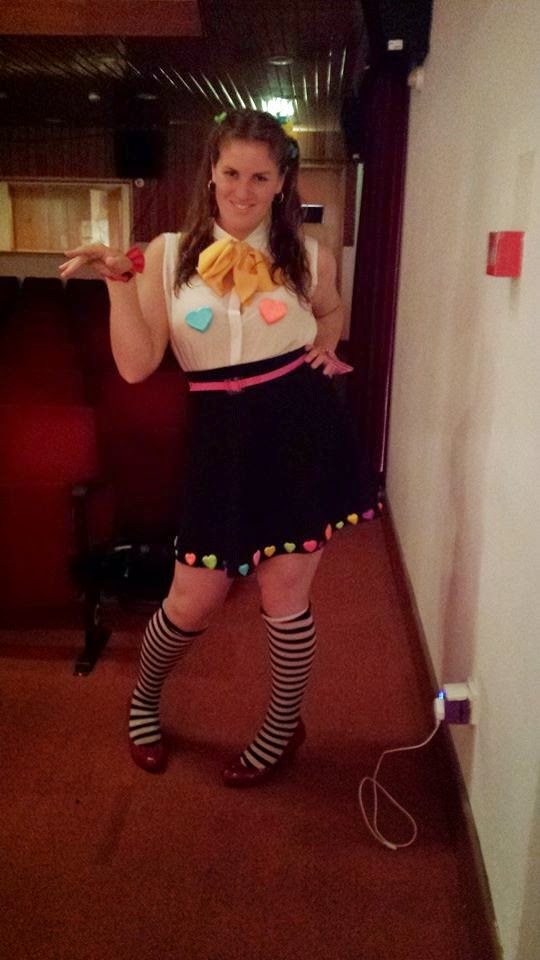
The most exciting part of the final phase of rehearsals is the addition of costumes.  Once again, my stepsisters had the most fun here.  Yes, Alidoro enjoyed playing a dirty tramp.  And Don Magnifico got some amusement out of his teddy bear and pyjamas – not to mention a particularly ridiculous wig.  But when it came to ridiculous costumes, the stepsisters definitely took the cake.  While Clorinda played a label-obsessed rich bitch, Tisbe was some sort of Britney Spears-inspired schoolgirl fantasy gone horribly wrong.  It's not so often that you hear a singer backstage hollering "has anyone seen my nipple heart?"

Tisbe's lovely costume
(I hear she's very popular in Japan.)

In comparison, my costume was what you might call… Spartan.  I got a shower cap and a paint-splattered boiler suit.  Not exactly the sexiest thing I've ever worn.  You'd have to really suspend your disbelief to think that the prince would fall instantly and madly in love with me.

In my sexy Act 1 costume with Prince Ramiro and Alidoro.

The best part of my costume was a fetching floral headdress/veil contraption which I got to wear to the ball.  It made me blind under the stage lights, and it wouldn't stay on without the help of several bobby pins, but I still loved it.

My beautiful veil for the ball

Underneath my boiler suit was the white lace dress I would wear to the ball, so that, with Alidoro's guidance, I could magically "transform" into a vision of feminine beauty.  Between this layering of costumes, the Portuguese summer heat, and the constant running around to fetch things for my stepsisters, I was in a pretty warm situation.  In fact, I can't remember sweating so much in a show since I did War and Peace, and we all had to bundle up for the Moscow winter under hot stage lights.  Every time I went backstage between scenes, I would unzip the boiler suit and start fanning myself furiously with a spare invitation to the ball.

When I wasn't recovering from the heat, I would enjoy another favourite backstage activity: dancing.

Yes, you heard me right.  While I'm waiting in the wings for my next entry, I like to get down and boogie.  The hustle, the robot, the mashed potato – you name it.  If it suits the music and the moment, I'm all over that cheesy dance move.  I know it sounds silly, but dancing backstage keeps my energy up between scenes.  It helps me stay focused, so I'm still mentally "in the show".  Sometimes if I'm lucky, I'll catch the eye of a castmate in the opposite wing and get them to crack a smile – or even to join in.

Cenerentola Gangnam style!

The second week of rehearsals also brought a first for me: my first ever stage kiss.  See, mezzos don't usually get to play the ingénue.  We're more often secondary characters – sisters, mothers, witches, or maids.  If we do get to play a love interest, it's usually a male one.  Which means kissing the soprano, not the tenor.  But even in a trouser role, I've never had the experience of kissing another singer in a show.  That is, not until I played Cenerentola.

Kissing onstage is one of the more surreal things an opera singer has to do.  It's weird enough kissing someone to which you have no romantic attachment whatsoever.  But to do it in front of an audience?  Awkwardness central.

Luckily my prince was someone I already knew well from Scotland.  It did also help that he wasn't straight – but then again, what tenor is?  Anyway, when I finally lost my stage kiss virginity it wasn't too weird or uncomfortable.  Being a seasoned stage kissing pro, my prince went in for the smooch without question.  And before I had time to get squeamish, it was all over.  Ok, so it was a bit weird when the director started critiquing our kiss and giving suggestions for angles and timing.  But I got over the weirdness after a few repetitions.  After a while it was just another piece of staging.

Thank goodness I didn't have a stage kiss like this!

As the dress rehearsal approached I developed a bit of a cold.  I was a bit worried, but not in any panic.  Luckily, although I felt a bit congested, the cold didn't seem to affect my voice.

Until it did.

The day of the dress rehearsal arrived, and I got through most of the opera without incident.  But in my final scene, my voice suddenly cut out.  I kept trying to clear my throat between phrases, hoping it was just a matter of removing some bothersome bit of phlegm.  But it was no use.  My voice had checked out, and had no intention of returning.

It was a terrifying feeling, being voiceless onstage.  I'd never experienced anything like it.  I imagine it's something like what a fish would feel like if he were swimming in open water and suddenly heard the theme from Jaws coming around the corner.  Exposed.  Helpless.  Doomed.

Uh-oh....

I finished the rehearsal marking quietly down the octave.  My final aria, which was supposed to be full of high notes and sparkling coloratura, was practically inaudible.  The performances were the very next day.  What would I do if I couldn't sing?

Over the next 24 hours, I went on a voice-saving mission.  I put myself on vocal rest, using a combination of written messages and mime to communicate with my colleagues.  I went to bed early and slept as late as possible.  And I guzzled water by the bottle-full.

ALL OF THE WATER.

The morning of the performances arrived, and I was in a real state.  I had dreamed of singing this role for so long.  I had been so excited to be cast.  I had talked about it to everyone I knew.  After all that build up, would I be able to sing the damn thing?

I arrived hours early at the theatre, intending to do a slow and careful warmup.  Instead I ended up crying in the toilets for a good half hour.  I had never felt so anxious about a performance in my life.

It took a spell on the theatre floor, practising all the deep breathing exercises known to man, but eventually I calmed down, drank more water, and began warming up in earnest.

And by some miracle, my voice was actually there.  Maybe it was all the hydration.  Maybe it was all the careful technical work I'd done singing the role into my voice.  Whatever it was, I sang through that cold.

I made it through two performances, and it all went swimmingly in the end.  Between scenes I spent a lot of time dashing to the toilets (I had drunk a LOT of water after all) and sucking on VocalZones.  But I still had time for the odd backstage boogie.  And we all had a load of fun.  Because, with Rossini, how can you not?

And they all lived happily ever after.

After such an intense work period, it's a shock to realise that the whole thing is over.  I can't help feeling a bit of the post-show blues, and wishing we could do just one more performance.  But luckily there's no time to dwell on my bel canto bereavement.  I'm already in Switzerland for the next project.  More on that soon…

Monday, 28 July 2014

The Cinderella Diaries - Part 2

So much has happened since I first arrived in Ferreira do Zêzere. Time has flown by, and we're now into the second week of staging for La Cenerentola.

The past week has been intense, to say the least.  It all began bright and early on the first day with a musical rehearsal.

The first sing-through of an opera is always a bit rough.  It takes time to get used to the other singers, to understand each other's voices and musicalities and really gel together.  And of course you want to make a good impression on the director, the conductor, and the other singers.  So at first everyone feels a bit stiff and shy.

"Wait... you want me to sing it now??"

But once the initial nerves wore off, it didn't take us long to warm to each other and really bond as an opera family.  Rossini's operas call for a lot of energy and humour.  Luckily this is something our cast has in spades.   We're a lively bunch of singers with an even livelier director, and our rehearsals have been full of belly laughs.

One thing we bonded over immediately is our astonishingly bad sense of direction.  One night after a couple of glasses of wine, I realised I had no idea how to find my way home in the dark.  My stepsisters had already left, and the women are staying in a different place than the men.  So my male colleagues, being chivalrous, decided they would help me find my way.  The only problem was that they were even worse at navigating than I was (and trust me, I'm really really bad).  Before we knew it we were hopelessly lost.  We finally gave up after an hour or so of wandering aimlessly around the Portuguese countryside.  It was almost midnight and after all, I didn't want to turn into a pumpkin.  So we headed back to the men's house and I slept on their couch.  We've got on like a house on fire ever since.

As for my stepsisters, they're as lovely offstage as they’re nasty onstage.  It's hard to pretend to be afraid of them when I know they're so sweet in real life.  Every minute they're not abusing me they're helping me up and apologising profusely for their fictional abuse.

Between the long hours of rehearsal, we like chat and relax together as we enjoy the delicious local coffee, the mouth-watering fresh fruit, and of course, my favourite Portuguese pastry, Pasteis de Nata.

The Best.

Since the first day, our staging rehearsals have moved ahead at warp speed.  Every day the director sets a goal for how many pages we'll get through, and come hell or high water we get through those pages.  Thankfully I feel very secure by now with my music.  My character, however, is another story.

Rossini's Cenerentola is a bit different from the Cinderella most of us know.  First of all she has an evil stepfather instead of a stepmother, and it's a servant of the prince instead of a fairy godmother who helps her go to the ball.  But more importantly, there are no helpful mice or magical wands to help Cenerentola find her prince.  She has to get by with her own spirit and determination.  And she doesn't accidentally leave behind a glass slipper.  She intentionally gives the prince one of her bracelets.  She tells him to come and find her.

So she's a unique kind of heroine.  On the one hand she's a victim of circumstance.  She's constantly bullied and belittled by her stepfather and stepsisters.  But on the other hand she's very strong.  She doesn't let anyone crush her spirit.  She insists on singing while she does her chores, even when her stepsisters try to stop her.  She still dreams of finding love, and even plucks up the courage to ask if she can go to the ball.  And when she arrives at the ball, she doesn't just let the prince make all the moves.  She sets her own terms: take this bracelet, come and find me.  Learn who I am before loving me.

Rossini's Cenerentola may be sweet, but she's certainly not passive.  As her feisty coloratura passages imply, she has fire in her belly.  She isn't a wet blanket or a timid little mouse.  She's a real protagonist.

The audience has to be on Cenerentola's side.  They have to want her to win.  So from the very beginning, even as she stays in the background cleaning, she has to shine with a certain kind of charisma.

Which is easier said than done.  How do I stand out as the star when I'm wearing rags and my two silly sisters are preening like peacocks in the foreground?  Even under the most ideal of circumstances, I'm not used to being the centre of attention.  How do I create my own spotlight without seeming to try?

Kid, you gotta have star quality!

I guess you could say that my diva skills are a bit rusty these days.  Since moving to Germany, I've mostly been getting work in choirs.  It's been at least six months since I've performed as a soloist, and at least a year since I've performed in an opera.

So as we began staging this week, I kept blending into the background.  Again and again my director would point out that I was turning away from the audience, or hiding behind a chair.  I didn't even realise I was doing it!  I was just so accustomed to shrinking back, being a secondary character in someone else's story.

"Oops... was I doing it again?"

One day after rehearsal, the pianist was telling me I had to give more onstage.  And I launched into a very familiar story.  I'm not a stage animal, I told him.  Acting doesn't come naturally to me.  I'm an introvert.  Despite my year at the opera studio, I still have so little experience onstage.  Other singers my age have done so many more roles.

The pianist listened to my excuses patiently.  Then gave me a puzzled look.  You're not such an introvert, he said.  Offstage, you're one of the most lively singers in our cast.  Why can't you bring that personality with you onto the stage?

......oh.

I was flabbergasted.  I had never thought of myself as lively or having a big personality.  But once I really thought about it, I had to admit that I've come out of my shell a lot in the last few years.  Yes, I am still an introvert in my own way – I still need some quiet and solitude to recharge.  But when I want to, I can be the life of the party.

So maybe it's time now to move past the old "introverted" label.  Time to embrace a new role, and take on the spotlight.

"Non piu mesta accanto al fuoco staro sola a gorgheggiar.."

With five days left until opening night, and the whole second act still to stage, we've got our work cut out for us.  The next week will either make or break me.  So it's time to step up now.  It's time to get up from the fireplace and let my inner diva shine.