Showing posts with label Health. Show all posts

Thursday, 12 March 2015

Ten Tips for Touring

As you may have noticed, I've been doing a lot of touring lately.  As well as travelling around Germany for various projects, this season I've been in a concert tour of China and Korea.  I just got back from a trip to Spain, and I'm now gearing up for a big tour of South America in April.

Being on tour is an intense experience.  You are with the same group of people, repeating the same programme and travelling together for days on end.  It takes a lot of energy and focus, as well as patience and good humour.  Here are some important things which I've learned about what it takes to be a happy touring musician...

(Psst... You might want to start by getting a bigger suitcase)


1. Stay on top of the paperwork

Touring is rarely as simple as flying from point A to point B.  Often you will have to travel to several different locations, and apply for all of the relevant working visas.  Take it from me – you should start on this as early as possible.  Usually your employer will tell you what you need and which forms to fill out, but you may also need to look into some of this stuff on your own.  And even when you think it's all sorted, there can always be further complications and delays.  I recently had to apply for a temporary second passport at the Canadian embassy, and I'm glad I started early.  As it turned out, they needed English translations of the letters from my employers.  This inevitably took some extra time.  Imagine if I had left all of this until the last minute.  I would have never got the passport in time for the tour.  I would have been landlocked, and lost out on ten days of work!

2. Be prepared for anything

Sunshine, rain, snow, plagues of locusts – you need to pack for every possibility you can imagine.  You'll be kicking yourself if you get to a cold concert hall and realise you've forgotten your long sleeves at home.  Never say never.  Anything can happen on tour.

Betty and Jim really wished they had brought their locust repellent with them to Egypt.


3. Bring along a piece of home

Travelling from hotel to hotel can be stressful and exhausting.  So it's important to make your temporary residence as comfortable and home-y as possible.  Everyone has different things which make them feel at home.  Whether it's a cup of tea, a pair of fuzzy slippers, or a favourite movie on their laptop, these things can transform a cold soul-less hotel room into your home away from home.  Don't underestimate the importance of these small creature comforts.  They can really help you negotiate the stress of long-term travel.

Fuzzy slippers are really important, you guys!


4. Find some regularity

Another way to handle the stress of touring is to create your own regularity within the irregularity.  Having some routines and habits can help everything feel a lot less chaotic.  I have a bit of a ritual when I arrive at a new place.  I unpack my suitcase in a particular order, I have a short nap if there’s time, and then I warm up before heading to the venue.  It's important to me that I unpack right away, so that I can feel settled as soon as possible.  Aside from my unpacking ritual, I am also a member of a gym which has locations all over Germany.  This means that no matter where in the country I'm working, I can always go to my gym and know my way around.  These may seem like small details, but they really help me feel comfortable on the road.

5. Do some forward planning

When you’re travelling for work, there isn't as much space for being spontaneous as there would be on holiday.  Your sightseeing time is limited, and you can't just wander aimlessly hoping to run into something cool.  So research the places you'll be visiting.  What is unique there which you absolutely must see?  When might you have time between rehearsals and concerts to go and see it?  I'm not saying you have to make yourself a detailed itinerary, but it helps to have a rough idea of what you will see when.  I had an amazing visit recently to the Guggenheim Museum in Bilbao.  I was particularly inspired by the exhibit of Niki de Saint Phalle.  I'm so glad I put some time aside to go and see it!

Seriously, how cool is this??

6. Pace yourself

Touring requires a lot of energy and endurance.  You have to think of the long game – this is a marathon, not a sprint!  It is of utmost importance that you conserve your health and energy through to the very end of the trip.  Know your own body and be sensible enough to rest when you need it.  You may feel a bit blue about missing a night at the bar or an afternoon of sightseeing, but it's better to make that sacrifice than to end up sick for the rest of the tour.

"Ahhhh.... made it."


7. Keep it fresh

One of the toughest things about touring is that you're usually performing the same piece, over and over.  But just because the music is old news to you, doesn't mean it should sound like that to the audience!  This is the first time they're hearing your performance, and they want to hear something fresh and inspiring.  So don't let yourself coast.  Keep looking for new things in the music, and trying to outdo yourself.  Could that phrase have a smoother legato?  Could that high note have a better approach?  Remember – the biggest room in the world is the room for improvement.


This is also a very big room.

8. Set a budget

You can spend crazy amounts of money on tour if you’re not careful.  The last thing you want is to come home to an empty bank account!  Many employers will pay you a per diem for your meals, which can provide a good guideline for your daily spending limit.  However there are some companies who don't provide a per diem, and if you're not careful you can eat up most of your fee before you've even been paid.  I like to take out a set amount of cash every week, based on a daily spending limit.  Some days I might go above or below this limit, but I always make sure it averages out in the end.  As long as I don't need to take out more cash before the week is out, it's all good.  This trick is even easier if you're visiting a country with a different currency.  If you only buy so many pesos from your bank, you will only have so much with you on tour.

Benito Juarez is judging your spending habits.


9. Do it like the locals

Why go all the way to Japan only to spend all your time in Starbucks?  You have a unique opportunity here to explore a new country.  Get out there and enjoy it!  Check out the local food, the local wines, the theatres, the museums, the festivals and marketplaces – everything which makes this place unique.  You may never have a chance in your life to do all of this again.  So seize the day!

10. Schedule some time to crash post-tour

You will be tired after a tour, especially if it's a week or longer.  So for the love of God, don't plan an important meeting the day you get back!  Sometimes these things can't be helped.  But if you have any control over your schedule (which freelancers normally do) make sure you have an empty day or two when you get home.  You'll need this time to rest, recover, and tackle that giant mountain of laundry sitting in your suitcase.

"Send help!"


Touring can be a real hoot!  It can also be a gruelling nightmare if you're not careful.  In the end, it all comes down to how you approach it.  So be smart and organised, plan ahead, and try to keep a healthy balance between work and play.

I hope these tips will help you make the most of your next tour.  Happy travels!

Wednesday, 26 November 2014

Tips for Freelancing (Part 1)

I'm still pretty new to the whole freelancing game.  In no way would I consider myself an expert on how to do it successfully.  However, I have been freelancing for just under five years now.  And that's enough time to make some significant mistakes.

There are a lot of important things which nobody tells you in school about being a freelance musician.  And so, over the last few years, I've often had to learn things the hard way - through screwing up, falling on my face, and generally being an awkward turtle.


But fear not!  You don't have to learn things the way I did.  I've decided to compile a list of freelancing tips, based on what I've learned through trial and error.  Think of these as the ground rules for gigging.  I originally intended this to be one post, but as it turns out, I have a lot to say on the subject.  So let's begin now with part one of... well, many.

1. Don’t just be on time, be early!
Especially if you're travelling to a new venue.  Many are the times I've found myself running around in a confused panic, searching for a church or a concert hall in an unfamiliar neighbourhood.  

"Where is the venue??  WHERE IS THE VENUUUUE????!!!!"

Granted, I have a terrible sense of direction.  But even if you were born with an infallible built-in GPS, it's always a good idea to leave in plenty of time before the rehearsal or performance begins.  Expect the unexpected – leave extra time in case there's a delay on the train or bad traffic, or, yes, in case you get lost.  Even if there are no delays, it's always good to have a nice window of time between arriving at the venue and beginning to sing.  This way you can get your bearings and relax a bit.  Nobody works well when they're feeling rushed, disoriented, or stressed out.

2. Leave your problems outside of the venue.
Whether you're annoyed with your landlord or just had a fight with your wife, your colleagues don't want to know about it.  Sure, artists are emotional creatures.  But if you want to be a professional artist, you need to learn to control when, where, and how you vent your feelings.  Your personal life and your changing moods should not affect the quality of your work.  Your problems should not become your coworkers' problems.  Work on maintaining a pleasant and professional attitude, no matter what you may be feeling on a given day.


3. Never take any work for granted.
It's a great feeling when someone is hiring you on a regular basis.  Congratulations  they like you!  But unless you're on a full-time, permanent contract with them, you should never assume that they will continue to call you for every gig.  I hate to break it to you, but as a freelancer, you should always feel at least a little bit insecure about your work.  This means you should always aim to impress with your musicianship and professionalism, and remind people why you're the best for the job.  It also means you should always be hustling for new work.  Remember: complacency is the enemy.

4. Watch your money.
Probably the hardest thing about being a freelancer is the cashflow.  One month you might make thousands, and the next month might be a big fat goose-egg.  In the meantime, most employers expect you to pay your own travel costs up front.  And as a younger musician you'll be investing a lot of your earnings back into your career with things like lessons, recordings, website building, and travel to auditions.  You have to spend money to make money.  So it's important to learn to be careful with your cash.  Always be looking ahead.  If this month is more lucrative than the next one, try to pinch your pennies while you can.  You may find yourself eating ramen noodles while you desperately await your next paycheque, only to spend it all at once in a rush of relief and euphoria when it finally arrives.  It's a dangerous financial trap to fall into.  But with some planning and budgeting, you should be able to stay on a more even keel.

Don't do this on payday.

5. Keep it respectful.
This goes without saying when you're dealing with other professionals.  But I would say it's especially important when you're helping out at an amateur gig.  Maybe these people aren't as musically educated or sophisticated as you are.  Maybe they're out of tune and can't count to save their life.  But while this is just another gig to you, it probable means the world to them.  Chances are they've been rehearsing for this concert for months, and it's the big musical event of their season.  So please, have some respect.  Don't make snide, snobby remarks or give exasperated sighs at their mistakes.  These people are making music for the joy of it, to connect with people in their community.  Can you imagine a cause more noble than that?  Amateur musicians deserve your respect just as much as professionals – if not more.

6. Be nice to your management.
I've often seen animosity develop between artists and management, and it can create a very unpleasant atmosphere.  Most of the time this comes from misunderstanding and a lack of empathy on both sides.  From the artists' side, I'd say it's important for us to remember that people in arts administration often deal with an enormous workload, long hours, and a high-pressure work environment – and all for very poor money.  They care a lot about their job, and they are doing their best to take care of the musicians.  Perhaps you're annoyed with a mistake they made in your paperwork.  But while you are only dealing with your own paperwork, they're dealing with the paperwork for all the musicians involved in this project.  So when communicating with your management, try to come from a place of compassion and understanding.  Always give them the benefit of the doubt.


7. Take responsibility for yourself.
As a freelancer, you are your own boss.  This means that nobody else is going to motivate you, hold you to task on important goals, or keep you on any kind of regular schedule.  It all comes down to you.  So man up and take charge.  Be proactive.  Be disciplined.  Be the captain of your own ship.

If you want to feel like a real bad-ass, pretend it's a pirate ship.

8. Take care of yourself.
Your well-being is your livelihood.  So do whatever is necessary to make sure you're happy, healthy, and in good singing/playing form.  Eat good nutritious food, get plenty of sleep, and don't forget regular exercise.  It's extremely important for you to be in good physical shape.  After all, performing is very physical work.  You need good breath support and muscle control, as well as the ability to move well on stage.  But beyond that, you'll find that being fit just helps you feel good. I joined a gym a couple of months ago, and it's been a real revelation.  I find that I have more strength and energy in my day-to-day life.  Travelling is much easier – I bounce back more quickly from long journeys and jetlag.  Furthermore, going to the gym adds a bit of structure to my routine – which tends to be pretty chaotic most of the time.  If you need more good reasons to exercise, check out my post about it here.

Let's get physical!


9. Rest when you need it.
I get it.  You're young and ambitious and you want to do everything NOW.  But taking days off is an important part of your practice.  If you don't have the discipline to not practise right now, you may run into serious physical and technical problems in the next few years.  I try to have one non-singing day every week.  This is not always possible, but I find it's a good guideline to aim for.  Regular rest is essential if you want to stay in top form.

10. Get a life.
I always hear people say "music is my life", as if it's something to be proud of.  But if music really is your life, you're setting yourself up for trouble.  You can't let all your happiness depend on one thing.  You need other dimensions to your life in order to feel balanced and fulfilled.  Get a hobby.  Join a club.  Buy a pet.  Or just make friends with people who aren't musicians.  Anything that adds to your life and isn't connected to your music will make you a happier, healthier, and more well-rounded person.

That's all for now.  Stay tuned for more tips soon!

Tuesday, 7 October 2014

On happiness...

Whenever I go home to visit my family, I find myself taking stock of my current situation.  I reflect on my decision to move to Germany, and the life I've built for myself there.  And the same question keeps coming back to me.

Am I happy?

It's a funny thing, this word "happy".  We're all taught that it's something we should want.  The Americans even go so far as to put it in their Declaration of Independence: life, liberty, and the pursuit of happiness.  Happiness is something we chase, covet, and put on display.  But what is happiness, really?

A few months ago I joined this online project called 100 Happy Days.  The idea is that for 100 days, you post a picture every day of what makes you happy.  People who've participated in this project say that it's helped them to feel joy and gratitude in their life.  To appreciate the little things.  To notice the things they were taking for granted.  Sounds pretty good, doesn't it?

When I started 100 happy days, I was in a bit of a funk.  The freelance lifestyle was really grinding me down.  I was tired, frustrated, and burnt out.  I thought something like this might improve my day-to-day life.  Maybe it would help me feel better about the world and myself.

And at first, it did.  Having to choose something positive in every day can really change your outlook on things.  I noticed things like sunshine and good cups of coffee.  I felt grateful for cute dogs and long walks.

NEWSFLASH: PUPPIES ARE ADORABLE

It didn't just change my outlook – it changed my whole approach to life.  You see, these days my life seems to take on a sort of all-or-nothing approach.  When I'm on a project, I work and socialise very intensely.  But when I'm at home between projects, I become something of a recluse.  I sit at home drinking tea and watching terrible German television.  Of course, a bit of rest is necessary after long weeks of travelling and singing.  But then that bit of rest always tends to drag out a little too long.  And before I know it, my time at home becomes a long string of "nothing" days.  I do nothing special or nice.  I do nothing memorable or worthy of notice.  I get up, I practise, and I rinse and repeat.  And the time ticks away, meaninglessly.

Once I started 100 happy days, I couldn't have any more nothing days like that.  Every day I had to take a photo of something that made the day special.  And there are only so many photos you can take of the television screen, or your favourite pair of slippers.  So I had to get out there in the world.  I had to be kind to myself, and seek things that made me feel good.

All in all, the project seemed to be good for me.  I was appreciating little things, and finding little things to appreciate.  Surely that would make me feel happy, right?  If I kept looking for happy things, and pointing out happy things, then I must, by default, feel happy myself.

The only problem was, I wasn't happy.  At the time, I was frustrated with my career, which seemed to be going nowhere fast.  I was putting in long tedious hours of rehearsal for very little money.  And I had crippling back pain which just wouldn't go away.

At first I thought putting a smile on things would help.  Finding something to be "happy" about, even though I wasn't able to walk that day.  Isn't that the kind of stuff motivational posters are made of?

[Insert cheesy you-can-do-it quote here]

But it didn't help.  In fact it seemed to make things worse.  On days where I was feeling miserable, the last thing that I needed was a reminder that I was "supposed" to feel happy.  The 100 happy days project began to feel like a guilt trip.  Look at this wonderful thing – shouldn't it make me feel good?  Shouldn't it make me feel thankful?  How could I possibly stay unhappy despite its existence?

The answer, it seemed, was that I must be ungrateful.  I must be spoiled.  What kind of miserable person would refuse to feel happy in a world full of sunshine and kittens?  Surely I had to look on the bright side.  Surely I had to see the good in everything.

And so this project – which was supposed to help me enjoy my life – became a burden.  It was an annoying daily chore.  I resented it.  I dreaded it, the way I used to dread doing my math homework in school.

And yet I kept pushing myself to do it, every single day.  Why?

Like many people in our society, I was obsessed with the idea of happiness.  I believed in positivity and "looking on the bright side".  And I felt an immense pressure to present a smiling face to the world at all times.

"I'm... so... happy!"

After all, nobody wants to hear about unhappiness.  Nobody wants to hear why your life sucks.  Why would I unload that kind of emotional baggage onto other people?  People like to hear about the funny things, the exciting things, the enjoyable things.  They certainly don't want to hear about doubts, anxieties, frustration, sadness, anger, or loneliness.  I felt I owed it to the world to stay bright and cheerful.  To avoid polluting the air with my discontent.

And of course, there was an element of pride in there too.  If I admitted I was unhappy, it meant I was weak.  It meant I was a failure.  I had taken big risks moving away from home and pursuing a singing career.  And I so wanted to prove to others that I was right.  I wanted to be a success story.  I wanted to show that the risks I'd taken had been worth it.

Like many people, I often used social media to present a skewed, overly-positive version of my life.  And in return, I saw skewed versions of my friends' lives.  I felt a need to measure up, to show off, and to out-happy them.

The crazy thing is, for the longest time I thought this was healthy.  I thought that positivity and optimism, in any measure, at any cost, had to be good.  And if I just kept "looking on the bright side", my life would improve.  I could make myself feel happy.

"Always look on the bright side of life..."

It took me a long time to understand that I was playing a game of deception.  This kind of relentless "positivity" was not good for me.  It was a toxic lie which I was trying to sell to myself and others.  And dishonesty is never healthy for anyone.

The truth is, not all days are going to be happy ones.  Some will be good, some will be bad, and some will just be "meh".  And that’s the way it's meant to be.

Can you imagine if every day was wonderful?  It would get pretty boring after a while.  In fact, it wouldn't feel wonderful at all, because you wouldn't have any point of comparison.  You can't appreciate happiness if it's the only emotion you ever feel.  It would be like living in a world where the only colour is yellow.

"...Dave..?  Is that you...?"

Instead of holding every day to some impossible standard of "happiness", why can't we just accept where we are at the given moment?  Maybe you're feeling a bit sad right now.  That's ok.  You're also allowed to feel angry if you like.  Sometimes life really does suck.  And it's important to let yourself feel that, just like it's important to let yourself enjoy life when it's good.

At some point, the 100 happy days project fell by the wayside.  Party because I didn't have internet in my new apartment, and it was too much hassle to post every day.  But also, it didn't sit right with me anymore.  I didn't want to force myself to feel one emotion all the time.

The strange thing is, once I stopped being so self-conscious about being happy, I felt happy a lot more.  I still had my ups and downs.  And some days still passed by with nothing really special happening.  But when the good times came, I really enjoyed them.  And when the bad times came, I didn't worry that I wasn't enjoying them.  I let them pass over me.  I let myself feel what I was feeling.  And everything was ok.

What is happiness?  It's what happens to you when you stop trying to chase it.  The minute you start wondering "am I happy?", you can pretty much guarantee that you won't be.  Happiness isn't meant to be pursued, or examined, or gripped onto.  It's something that arrives without warning and leaves just as unexpectedly.

Happiness: the ultimate ninja.

It's been over a year now since I moved to Germany.  And yes, I am happy.  I'm also sad, angry, confused, pensive, anxious, and many other things on top of that.  And you know what?  I think that's ok.

Saturday, 6 September 2014

Interview with Barbara Hannigan

I'll never forget the first time I saw Barbara Hannigan perform.  It was two years ago in Gothenburg, Sweden.  She started off with some Rossini and Mozart, singing and conducting simultaneously with flawless elegance.  Then in the second half of the programme she came trotting out in head-to-toe black leather, and gave the most wacky and electrifying performance of Ligeti's Mysteries of the Macabre you could imagine.  It didn't take long after that for Barbara to become my major girl crush on the classical music scene.  I mean, she's just so effortlessly cool!  Whether she's performing Lulu in pointe shoes, conducting Fauré’s Pelléas et Mélisande, or premiering a composer's new work, she always kicks ass and looks good doing it.  So of course I was pretty excited to participate in her masterclasses at the Lucerne Festival.  Barbara is an incredibly open and generous teacher.  She gives us advice on everything from technique and professional etiquette to choosing the right skin products and overcoming jetlag.  In the hours between the dress rehearsal and the final concert, we share a cup of tea at Barbara's Lucerne apartment.  As I sip my Throat Soother (with honey, of course) Barbara talks to me about the masterclasses, her trailblazing career, and what it takes to be a star soprano.

Barbara Hannigan (Photo credit: Elmer de Haas)

You moved to Europe in your early twenties.  What was it like adjusting from your life in Canada?

It was very difficult actually.  I had left home, which was Nova Scotia, when I was 17, and then when I was 23 I moved to England…  I studied there for one year.  I was extremely lonely.  It was a very big city.  Even though everyone was English-speaking I have to say the culture shock was pretty intense.  I felt that there was quite a strong prejudice at the school I was at, from the vocal department, against contemporary music.  I had a lot of trouble getting any teachers to even hear me.  They wouldn't let me audition.  So that was even more isolating.  After a very lonely and frustrating year in England, I moved to Holland… and then I went to the Hague Conservatory.  I did a one-year opera programme, but then I kind of kept my foot in Holland because I was working there.  I kept one foot in Canada and one foot in Holland, and it pretty well stayed that way until I made the complete move to Holland, which would have been 2001.

Did you always know that you wanted to stay in Europe?

No, I didn't know that at first, and like I say the loneliness was really hard for me to deal with.  Just the bureaucracy of a country with which you're not familiar – I mean being an immigrant or a resident, it's really hard.  All the day-to-day things that seem so easy in your home country: banking, hospitals, you know simple things, are just – it seems impossible in the new country.  Doctors, everything.  It's really really hard to negotiate for yourself and it takes a lot of time and energy.  I think it was in 2001, when I went to Holland looking for a short-term place… In September of that year I ended up basically being handed a wonderful apartment in Amsterdam.  Which was owned by Reinbert de Leeuw, the conductor and mentor of mine, who's a very important figure in my life.  I was able to live there at a rent that I could afford and choose myself, for a good 5 years.  I just decided to stay after that.  That was it.

What draws you to contemporary music?

I think I've always liked it since I was a child.  I think part of the reason maybe that I enjoy it was that I felt like I was walking in snow that nobody else had walked in yet.  I was making my own path and my own footprints, and I didn't have to follow the length of someone else's steps.

Making new footprints

There was no kind of tradition… When I was younger I was intimidated by the "tradition": this is how you sing this song.  Which seemed to me to have nothing to do often with what was on the page.  Whereas in contemporary music, you sang what was on the page.  So I could identify with it and I knew I could do that.  Now I realise that that's actually what one should apply to all music.  But at the time I felt free in contemporary music, I felt like I could expand and that I was ok and I could be myself.

I think another thing that drew me to contemporary music is that, you know, I moved to Toronto when I was 17.  I went to university for my bachelor when I was 18 – that's very young.  My voice was clear and I had a strong musical sense – not sophisticated, but I had good pitch and good rhythm.  My voice needed to catch up, and so while it was catching up I was the darling of the contemporary music people because my voice was very pure and clean.  I didn't have any bad habits and I didn't scoop and I didn't have a big vibrato, so it was kind of what a lot of composers really enjoyed working with.  And of course I was game for anything.  I was really open-minded. 

How do you approach learning a new score?

I avoid singing it for as long as possible, depending on how much time I have.  This is because I am a good sight reader, but I don't feel that sight reading – like literally reading at sight – is good for the voice.  I feel that one should familiarise oneself with the score, with the lay of the score, with the landscape of the score, before you sing it.  So you know where the uphills are, you know where the downhills are, you know where you're coasting, you know where you're going through passaggio.  You have an idea of what are going to be the most virtuosic passages, and those are to be practised extremely slowly.  There is a method about it, and that's probably why I get frustrated if, on occasion, I get the score late, because I feel like my method has been interrupted and I can no longer work at the pace that I feel serves the music best. 

Barbara performing in Alban Berg's Lulu.

Are there any particular performers that really inspire you?

I have a lot of respect for lots of different singers, and for many different reasons.  Like I love the way Bartoli sings – I'm pretty well sold on everything she does because she has so much joy and pleasure in singing.  But I also like someone that's more muted in a way, like Anne Sofie von Otter.  I do appreciate her a lot.  Lorraine Hunt Lieberson is a singer whose voice I really love.  Renée Fleming is someone for whom I have a lot of respect and in some repertoire I just adore her voice.  Then also someone like Fritz Wunderlich, like the older singers, I also appreciate for various reasons.

But it's not really singers from whom I draw my inspiration as a performer.  In fact I don't use them as examples for me when I'm making sound.  I will think of the way Glenn Gould articulates a certain phrase… I think about the martial arts actor/comedian Jackie Chan.  His transitions, his sense of rhythm, is pretty amazing, and I'd also imagine him when I'm singing.  Danny Kaye.  Julie Andrews, I think, is a pretty phenomenal performer and I admire her greatly, and I do often write "Julie Andrews" in the score.  There’s a Sound of Music moment, really, in most contemporary music I sing.  I'm sure she would just laugh her head off if she ever found out!

The hills are alive... with the sound of contemporary music!

Then film characters or a scene with a particular actor, how to play something.  Christoph Waltz in Inglorious Basterds – the Quentin Tarantino film for which he won the Oscar.  I mean he was playing the bad guy so well and with such pleasure and articulation and timing.  He was a pretty big influence for me.  So in my singing I’m not influenced by singing.  But I appreciate singers.  Very much.

How does it feel to go from the role of performer to the role of teacher?

I kind of feel like both are just leadership positions, so there isn't really a big change…  I find the teaching tiring because I get involved emotionally.  It's very hard not to notice the hopes and dreams of people.  You also see people's particular sensitivities.  Or you want someone to open something up and you can't get them to do it, and you're trying to help, and it can be hard.  So I find that tiring.  Of course, six hours a day of being in front of other people is a lot.  Somehow in an opera when I'm just singing it's easier – although even a six-hour opera day is really hard, I find six hours a day of masterclasses is even harder.

Barbara teaching in Lucerne.

We've been starting every day this week with a yoga class.  How do you find that health and fitness serve your singing?

In a really big way it serves my singing, partly because it gets me in good physical shape so that nothing can phase me.  Even if I'm doing a dance show.  I'm in strong cardio shape.  I always go running...  I really try to be physically strong.  Just so that there isn't anything that can phase me in an opera staging.  But also the other reason is that it's good for your mind.  It's good for you mentally to be physically strong.  First of all the yoga or the running, it really has a meditative quality so that it clears the mind.  Then it also gets rid of a lot of toxins or negative feelings in your body, so that you can be more positive towards your work.  I think generally physical fitness gives us positive endorphins, and therefore we're better disposed to serving the music.

You’ve often talked to us about discipline.  Why is this such an important part of your life?

Well because I want to have a long and enjoyable career, and I find that the way to enjoy your work is to be prepared and to be disciplined about it.  Performance anxiety, for example, is greatly alleviated by preparation.  Preparation can't happen if you have a chaotic life.  You may think I have a chaotic life because I spend all these months on the road, but I'm regulating my schedule as much as I can.  My daily schedule, my travel schedule, what I eat, where I eat, with whom I eat.  You know, who gets my energy, who doesn't.  I spend a lot of time alone.  As much as I can.  I like to be alone, and I just feel like the discipline is related to keeping me as calm as possible so that I can handle the stress.  Because the stress of having a career at the pace which mine seems to be moving right now is very high.  I don't think there's a lot of people that could handle that.

Singer, conductor, superwoman.

You've carved out a very unconventional career path.  How did you deal with it when people were trying to steer you in another direction?  How did you handle the naysayers?

Well, luckily my teachers were quite supportive of my path, whatever it was.  That was really important.  They believed in me.  I was always lucky.  I had one teacher who wanted me to sing the bel canto [repertoire], and yet when he came and heard me sing a really contemporary music concert once he was kind of flabbergasted because he realised that this was like home for me.  And over the years he's become incredibly supportive.

As far as having agents, I mean I had an agent early on who basically wanted me to sing – I think his dream for me was to be like Edita Gruberova…  He thought of all contemporary music as "squeaky gate" music, that's what he called it.  So he just lumped it all into one category.  He really went out of his way to make sure that I didn't sing this music anymore.  At a certain point I just – I left him because I felt… I was unhappy and he was probably frustrated, and so I left and I went for a long period without any management…  So it was a struggle, and I mean I'm really happy that I remained true to my repertoire.  I really sing the music that I like to sing and I do not sing music I don't like.  That includes saying no to a lot of contemporary music that I don't want to sing, or a composer with whom I don't feel an affinity.  It was kind of a hard path, and it was only four years ago that I joined my manager, with whom I have a very positive and supportive relationship.  It took a long time to get to that stage, I mean I'd already been performing professionally for 20 years – since I was 19.  And I was 39 when I moved to a really big manager.  So that's kind of something, you know?

Thanks for chatting, Barbara!

Wednesday, 6 August 2014

The Cinderella Diaries - Part 3

It's hard to believe that our production of La Cenerentola is over.  The past two weeks have flown by in a blur.  And at the same time they've contained an eternity.

In the second week, our rehearsals began to pick up momentum.  We finished staging within two days, and it was an enormous relief to know that the entire opera was now blocked.  After revising a few scenes – reducing the overall levels of faffage – we began to do run-throughs.  It was so satisfying to see the show come together in its entirety.  We had spent so long fussing over little bits and pieces, and now we finally began to see the fruits of our labour.  The opera started to make some sort of sense.

Of course, being Rossini, it didn't really make sense at all.  The whole production was extremely silly in the best possible way – full of slapstick gags and physical comedy.  Most of this was carried out by my two stepsisters, who strutted about and slapped me around and bickered over their shopping bags.  I have to admit, I envied my sisters in a way.  They may not have had the most beautiful phrases to sing, but they certainly got to have the most fun onstage.

Clorinda struts her stuff.

At first I was pretty anxious about the whole physical comedy thing.  It's not that I didn't love the idea in principle.  I just wasn't sure my body would be up for the job.  My knee was still in poor shape, and while I was wearing my incredibly attractive knee support to every rehearsal, some movements were still pretty tricky.  But with time I gained fitness and confidence, and was amazed and relieved to discover that I could run, crouch, lift heavy objects, and even fall to my knees.  As rehearsals went on I slowly weaned myself off of my knee support, knowing I wouldn't be able to wear it in performance.  And it was all ok in the end.

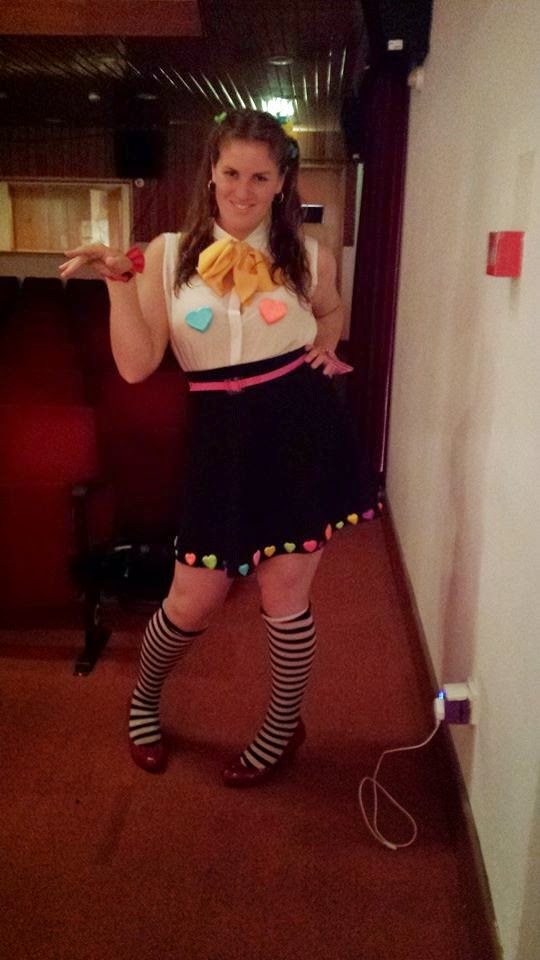
The most exciting part of the final phase of rehearsals is the addition of costumes.  Once again, my stepsisters had the most fun here.  Yes, Alidoro enjoyed playing a dirty tramp.  And Don Magnifico got some amusement out of his teddy bear and pyjamas – not to mention a particularly ridiculous wig.  But when it came to ridiculous costumes, the stepsisters definitely took the cake.  While Clorinda played a label-obsessed rich bitch, Tisbe was some sort of Britney Spears-inspired schoolgirl fantasy gone horribly wrong.  It's not so often that you hear a singer backstage hollering "has anyone seen my nipple heart?"

Tisbe's lovely costume
(I hear she's very popular in Japan.)

In comparison, my costume was what you might call… Spartan.  I got a shower cap and a paint-splattered boiler suit.  Not exactly the sexiest thing I've ever worn.  You'd have to really suspend your disbelief to think that the prince would fall instantly and madly in love with me.

In my sexy Act 1 costume with Prince Ramiro and Alidoro.

The best part of my costume was a fetching floral headdress/veil contraption which I got to wear to the ball.  It made me blind under the stage lights, and it wouldn't stay on without the help of several bobby pins, but I still loved it.

My beautiful veil for the ball

Underneath my boiler suit was the white lace dress I would wear to the ball, so that, with Alidoro's guidance, I could magically "transform" into a vision of feminine beauty.  Between this layering of costumes, the Portuguese summer heat, and the constant running around to fetch things for my stepsisters, I was in a pretty warm situation.  In fact, I can't remember sweating so much in a show since I did War and Peace, and we all had to bundle up for the Moscow winter under hot stage lights.  Every time I went backstage between scenes, I would unzip the boiler suit and start fanning myself furiously with a spare invitation to the ball.

When I wasn't recovering from the heat, I would enjoy another favourite backstage activity: dancing.

Yes, you heard me right.  While I'm waiting in the wings for my next entry, I like to get down and boogie.  The hustle, the robot, the mashed potato – you name it.  If it suits the music and the moment, I'm all over that cheesy dance move.  I know it sounds silly, but dancing backstage keeps my energy up between scenes.  It helps me stay focused, so I'm still mentally "in the show".  Sometimes if I'm lucky, I'll catch the eye of a castmate in the opposite wing and get them to crack a smile – or even to join in.

Cenerentola Gangnam style!

The second week of rehearsals also brought a first for me: my first ever stage kiss.  See, mezzos don't usually get to play the ingénue.  We're more often secondary characters – sisters, mothers, witches, or maids.  If we do get to play a love interest, it's usually a male one.  Which means kissing the soprano, not the tenor.  But even in a trouser role, I've never had the experience of kissing another singer in a show.  That is, not until I played Cenerentola.

Kissing onstage is one of the more surreal things an opera singer has to do.  It's weird enough kissing someone to which you have no romantic attachment whatsoever.  But to do it in front of an audience?  Awkwardness central.

Luckily my prince was someone I already knew well from Scotland.  It did also help that he wasn't straight – but then again, what tenor is?  Anyway, when I finally lost my stage kiss virginity it wasn't too weird or uncomfortable.  Being a seasoned stage kissing pro, my prince went in for the smooch without question.  And before I had time to get squeamish, it was all over.  Ok, so it was a bit weird when the director started critiquing our kiss and giving suggestions for angles and timing.  But I got over the weirdness after a few repetitions.  After a while it was just another piece of staging.

Thank goodness I didn't have a stage kiss like this!

As the dress rehearsal approached I developed a bit of a cold.  I was a bit worried, but not in any panic.  Luckily, although I felt a bit congested, the cold didn't seem to affect my voice.

Until it did.

The day of the dress rehearsal arrived, and I got through most of the opera without incident.  But in my final scene, my voice suddenly cut out.  I kept trying to clear my throat between phrases, hoping it was just a matter of removing some bothersome bit of phlegm.  But it was no use.  My voice had checked out, and had no intention of returning.

It was a terrifying feeling, being voiceless onstage.  I'd never experienced anything like it.  I imagine it's something like what a fish would feel like if he were swimming in open water and suddenly heard the theme from Jaws coming around the corner.  Exposed.  Helpless.  Doomed.

Uh-oh....

I finished the rehearsal marking quietly down the octave.  My final aria, which was supposed to be full of high notes and sparkling coloratura, was practically inaudible.  The performances were the very next day.  What would I do if I couldn't sing?

Over the next 24 hours, I went on a voice-saving mission.  I put myself on vocal rest, using a combination of written messages and mime to communicate with my colleagues.  I went to bed early and slept as late as possible.  And I guzzled water by the bottle-full.

ALL OF THE WATER.

The morning of the performances arrived, and I was in a real state.  I had dreamed of singing this role for so long.  I had been so excited to be cast.  I had talked about it to everyone I knew.  After all that build up, would I be able to sing the damn thing?

I arrived hours early at the theatre, intending to do a slow and careful warmup.  Instead I ended up crying in the toilets for a good half hour.  I had never felt so anxious about a performance in my life.

It took a spell on the theatre floor, practising all the deep breathing exercises known to man, but eventually I calmed down, drank more water, and began warming up in earnest.

And by some miracle, my voice was actually there.  Maybe it was all the hydration.  Maybe it was all the careful technical work I'd done singing the role into my voice.  Whatever it was, I sang through that cold.

I made it through two performances, and it all went swimmingly in the end.  Between scenes I spent a lot of time dashing to the toilets (I had drunk a LOT of water after all) and sucking on VocalZones.  But I still had time for the odd backstage boogie.  And we all had a load of fun.  Because, with Rossini, how can you not?

And they all lived happily ever after.

After such an intense work period, it's a shock to realise that the whole thing is over.  I can't help feeling a bit of the post-show blues, and wishing we could do just one more performance.  But luckily there's no time to dwell on my bel canto bereavement.  I'm already in Switzerland for the next project.  More on that soon…

Tuesday, 15 July 2014

On listening to your body...

Just over two months ago, my back went on strike.  Completely gave out on me.  If I so much as tried to sit up, a sharp spasm of pain shot up and down my body, freezing me in place.  I couldn't stand.  I couldn't walk.  I was paralysed by pain.

It was a rather quiet picket line.

The warning signs had been there, of course.  This had not come out of nowhere.  Since the new year I had been suffering lower back pain on and off.  Sometimes it was tolerable, only a slight twinge here and there.  Other times it had me limping stiffly, wincing every time I stepped on my right side.  I stopped running and stopped wearing heels.  I consulted a doctor, and later an orthopedist.  The orthopedist prescribed painkillers, muscle relaxants, and physiotherapy.

The pills were easy enough to swallow, but the physiotherapy was hard to keep up.  I was travelling all the time for work and saw no need to slow down.  I only made appointments when I could, between gigs.  So my treatment ended up being completely inconsistent.  Always at a random time, and always with a different therapist.  The therapists gave me exercises, but I only did them occasionally, when I had time and remembered.  Most of the time I didn't bother.


I'm not sure what exactly I was thinking.  Maybe I expected the problem to go away on its own.  Maybe I thought I could reschedule its healing for a more convenient time.  Maybe I thought it would disappear with the help of a few magical pills.  In any case, I didn't make time for my body.  I simply didn't think it was important.

So the months went by and the pain continued, and I carried on travelling and singing as usual.  Until one day I flew to Sweden with a heavy backpack, and ended up immobilised on my boyfriend’s couch.

It's a funny thing, having a body.  Most of the time you don't really think about it.  As long as everything is working, you take it for granted.  It will always be there, carrying you from place to place, digesting your food for you, and taking whatever punishment you throw its way. 

My body and I have never had what you would call a healthy relationship.  As a young girl I always resented it for being bigger than other girls' bodies.  I called it bad names.  I told it I hated it.  I cried and complained about it.

Later, in my early twenties, I became bulimic.  During this time I committed horrific atrocities against my body.  I starved it.  I overexercised it.  I stuffed it full of junk food, poisoned it with laxatives, and forced it to throw up.  All of this my body suffered quietly, without complaint.

I am no longer bulimic, but I'm still very hard on my body.  I regularly put it through long journeys, alcohol-soaked weekends, sleepless nights, and stressful auditions.  I often feed it excessive amounts of fat, salt, and sugar.  Even when I’m doing something "good" or "healthy", like exercise, I don't do it to love or nurture my body.  I do it to punish it for last night's chocolate binge, or to control its weight and size.

Regretting another night with Ben and Jerry...

And I do all these things without thinking.  Because after all, I'm young.  I can get away with this behaviour.  My body can take it.  My body is invincible.

Until it isn't.

I suppose at a certain age all these things begin to catch up with you.  The wear and tear begins to show.  And suddenly you find yourself paying dearly for transgressions which used to go by unnoticed.

Back in Sweden, I spent four days lying on that couch.  It was a surreal feeling, suddenly losing the ability to move.  Getting up to go to the bathroom was a huge ordeal.  It would take several agonising minutes to sit up.  Then I would use my boyfriend's music stand as a walking stick as I hobbled across the room slower than an arthritic 90-year-old grandma.  The pain was horrific.  Even with the maximum dosage of painkillers and anti-inflammitants – I was taking 16 pills per day – it was excruciating to move.

My "stand-in" walking stick

Gradually, I began to rely less on my "walking stick" and limp without it for longer distances.  I began to walk again – still crookedly, and still with pain, but walking nonetheless.

And so began a long and arduous healing process.  From then on, I made my health a priority.  I visited doctors, orthopedists, chiropractors, and osteopaths.  Everyone had a different idea of what exactly was wrong and what I needed to get better.  It was difficult to weed through all the different opinions.  But I tried my best not to over-rely on popping pills, to listen to my body, and to figure out what was working best for me.  I dedicated time to my body every day.  Whether it was stretching, getting a massage, or simply resting when I needed it, I made sure I was taking care of myself.

I continued to work, which was a humbling experience.  Everyone noticed my limping and could tell how much pain I was in.  People were very sympathetic.  They meant well, but their concern often frustrated me.  I wanted to be strong and independent, not an object of pity.  Of course, by this point I was accustomed to my condition.  I had accepted that for the time being, this was the state my body was in.  But to everyone else – every new colleague and employer I encountered – it came as a fresh shock.  And I grew tired of hearing their shock, of thanking them for their "gute Besserung"s and accepting their opinions and advice on what I should do.

So. Many. Opinions.

There were times when I gave in to despair.  I cried about how unfair it all was.  Why did my body hate me so much?  What had I done wrong to deserve this?  When was I ever going to feel better?

Other times I let myself think I had found a miracle cure, a definitive diagnosis.  Now it was all over and everything would be fixed.

YESS!!!
Then a few weeks later things would take another turn for the worse and my frustration would return.  Whatever I did, it seemed my body would find a new pain or affliction to hold me back.

In my more lucid moments, I would think that my body was trying to tell me something.  But what?  Did I need to travel less?  Sleep more?  Eat better?  Cut back on coffee?

It took a while before I realised that my body's message could in fact be very simple.  Maybe my body just wanted me to notice it.  To acknowledge its presence, to thank it, and to treat it with some dignity and respect.

You see, that's the other funny thing about having a body.  You don’t really have your body, do you?  Your body is a part of you.  It's who you are.  And yet we insist on using this language of ownership.  As though our bodies are something separate.  A vessel, an unthinking object, a vehicle to transport our brains from point A to point B.

For as long as I can remember I've thought of my body as something completely remote from myself.  At the best of times I've tolerated its existence.  At the worst of times, I've berated it for being so fat, so ugly, so stupid and useless.  With all these aches and pains holding me back, the temptation to scream at my body has become bigger than ever.

But I don't want to keep screaming at my body.  I want to start a new dialogue, a dialogue of patience and understanding.  I want to connect with it, listen to it, learn to love and appreciate it.  Because my body is myself.  If I don't love my body, I don't love myself, and I am neglecting a huge part of what it is to be human.

I'm building a new relationship with my body, and it won't be built overnight.  It will take a long time to undo such a long history of abuse and resentment.  I need to accept that there are no miracle cures or overnight fixes.  Like any relationship, it needs time to develop.

This is the beginning of a beautiful friendship.

It's been over two months now since my back gave out on me, and the healing process is far from over.  After an MRI and a diagnosis of a bulging disc, I've been through a long stint of physiotherapy (this time with much more intensive and regular treatment).  But despite all the work in physio, all these months of limping have left me with a knee problem which just won't go away.  I begin staging for an opera in less than a week, and I'm still not able to walk completely normally.  I've had to inform the director of my physical limitations, and – perhaps even more difficult – I've had to accept for myself that I'll be working with a less-than-perfect body onstage.  It's not ideal, but it's the way things are.  And no amount of railing against fate or cursing my body will change that.

The best I can do now is to keep loving my body.  Nurture it, cherish it, thank it for everything it does.  And trust that in time, with the proper love and care, it will find its own way to heal.