Showing posts with label Dreams. Show all posts

Sunday, 5 July 2015

On signing the contract...

Another season is coming to its close, and, as my friend has been saying, change is in the air.  It seems these days almost everyone I know is on the move.  Some are going away to study, some are beginning new jobs, and some have won places in young artist programmes.

As for me, I am preparing for my fourth move in six years – and this time, my new home will be Austria.  I've just signed a two-year contract with the opera chorus in Innsbruck. 

My shiny new workplace

In a way, this turn of events has felt very sudden.  In another way, I sensed for a while now that it was going to happen.

You may have noticed I've been blogging a lot less lately.  The fact is, I've been too busy singing!  In the past six months or so, things really began to cook, and I had a very full calendar.  Lots of projects, lots of travel, and lots of performing.  It would seem, as a freelancer, I was doing pretty well.  Some people might even go far as to call me successful.

There's just one thing.  And I feel like I’m committing some kind of cardinal sin by saying this.  But here it is: freelancing made me unhappy.

I was exhausted by the constant travel.  I hated being away so much, and never feeling like I had a steady home base.  I was sick of airports and hotel rooms.  I worried constantly about money.  And I really struggled with the extreme emotional highs and lows.  Performances could make me feel on top of the world – but as soon as a project was over, I would crash into a post-performance slump, and feel like it was impossible to recover.

"Help!  I've fallen and I can't get up!"

I felt bad complaining, because I knew I should feel lucky to be making a living doing what I loved.  I knew some people might even see the work I had, the places I was seeing, and feel jealous.  I didn't want to seem ungrateful, or come across like I was having "first world problems".  But the truth is, freelancing made me feel anxious and exhausted all the time.

Some people love freelancing.  They love the adrenaline and excitement, the novelty of exploring new cities and working with new colleagues, the feeling of being a free agent and answering to nobody.   I have friends who thrive on the freelance life, and it's a beautiful thing to behold.  As for me, I've never managed to get past the feeling that I'm barely coping, struggling to survive.  It has never felt like a safe or sustainable way to live.


As my calendar got fuller and my "success" continued, I felt like the walls were closing in on me.  Something had to give.  Something had to change.  And then it did.

As I went from project to project, I continued to do auditions.   Nothing new there.  I've been doing auditions since I arrived in Germany.  It's become a predictable sort of routine.  I get invited, I prepare, I travel, I sing, and they say no.  Rinse and repeat.  The no's get less shocking every time.  I know it sounds twisted, but I've actually come to expect them.  I sigh, shrug my shoulders, pick myself up and start preparing for the next audition.  That's just the way it goes.  As it was, is, and ever shall be, world without end Amen.

But as I continued to audition, some small, almost imperceptible adjustments were taking place.  My German was improving.  I was settling into a more comfortable, confident attitude with audition panels.  I was more relaxed.  I felt more like myself.  I even began to – shock, horror – crack the occasional joke!

Perhaps most importantly, I was always busy with work.  Which meant that I was too busy to overprepare, overthink, or put too much pressure on myself to succeed in any one audition.  I had just enough time to practise my arias and sing them for the panel.  No more, no less.  In short, I stopped caring so much.


One day, I went to sing for a government agency in Stuttgart.  I had already sung for this agent a year ago, and it was completely fruitless, so I wasn't expecting anything.  To my surprise, they took me on, and immediately started advising me on some upcoming jobs.

I didn't really know how to react.  They said… yes?  That couldn't be right.  Surely it was some kind of mistake?

Who, me?

Once I got over the initial shock, I realised that, somehow, I must be doing something right.  I decided to keep the momentum going and audition immediately for the government agency in Cologne as well.  This time, the agent told me there was a job I'd be perfect for.  Could I audition in Innsbruck before the end of the June?  The next day the theatre phoned and asked when I could come and sing.

I couldn't believe it!  It seemed like everything was happening so quickly, so easily.  I was so used to hearing "no".  I was so used to struggling for everything.  Now suddenly I had taken a turn, and everything was falling effortlessly into place.  "Well," said my singing teacher, "it sounds like the universe is telling you that you're on the right path."

"That's right, this way, just keep going!"

Sure enough, a week later I found myself at the theatre in Innsbruck.  The audition went well, and they hired me on the spot!

This all happened over a month ago, and it still feels pretty surreal.  I've since signed a contract, had my first costume fitting, found an apartment in Innsbruck, and applied for my Austrian visa.  I've also gone through the business of informing employers and colleagues, and cancelling other upcoming work.  And yet no matter how many people I tell, somehow I still can't believe it.

Change is in the air, as my friend says.  And this change is a big one.  I'm still struggling to wrap my head around it.  Not only because I'm moving to a new country.  Not only because my fiancé and I will – once again – have to adjust to a long-distance relationship.  In fact, the very idea of having a job is blowing my mind.  It seems as if the whole definition and purpose of my life has changed.

For as long as I can remember, I've been practising so that I can perform well in auditions and win a job.  That was always my focus, my motivation, my raison d’être.  Now suddenly, I've got that job.  It's everything I've been working towards.  I'm finally safe, and I know I'll be able to stay in one place and receive a monthly salary for my work.

Strangely enough, as much as I’m happy and relieved by all this, it's also opening up some deep existential questions.  What do I sing?  Why do I sing?  Why do I exist, if not to work towards the next big audition?  What can I strive towards, what can I struggle with, now that this big question mark has been removed from my life?  How will it feel, no longer living on the edge?  Who is Diva on a Dare, when she's no longer Daring?


As I prepare to begin this new phase of life, I'm looking forward to more security, more stability, a better quality of life.  I'm sure I will feel much happier and healthier than I ever did as a freelancer.  I'm also sure that I have some soul-searching ahead of me.  It's time to discover who I really am, and why I really sing.  Once I stop struggling to survive, once I remove this relentless worry about what-comes-next… what will remain?

I can't wait to find out.

Monday, 20 October 2014

On finding clarity...

It's been a while now since I moved to Cologne, and dare I say it, I'm starting to feel pretty settled.  I have a flat here with my boyfriend.  A real flat, with our own lease and our own furniture and our own names on the mailbox (trust me, this is exciting).  I have teachers and coaches who I enjoy working with regularly.  I have some employment – enough to pay the rent, at least.  I have a gym.  I have a phone plan.  I even have a favourite café.

But something is missing.

Since moving to Germany, I've thrown myself wantonly upon the local music scene.  I've auditioned for anything and everything.  Agents, conductors, opera choruses, professional choirs and ensembles… you name it.  Some of these auditions were fruitful, some were ok, and some were downright disheartening.  But auditioning is an expensive and exhausting venture.  I can't keep on auditioning for everything like this – it's like shooting in the dark.  I need to start making smart decisions.  I need to find a focus.

And herein lies the difficulty.  What kind of career do I actually want?

Hmmmm....

I've reached an important turning point.  I can't go any further forward before I decide which direction I want to pursue.  Right now I'm making a living out of professional choir work, with occasional solo gigs.  If I follow this path to its logical conclusion, I will be aiming for a full-time choir job – possibly supplemented with some solo concert work.  And yet… I went to an opera studio.  I've always been aiming for a solo career in opera as well as oratorio.  Can I really just abandon this idea of myself as an opera singer?

If I do indeed want to keep pursuing opera, I need to work on a completely different skill set than the one I'm currently using.  And I need to start learning important "staple" roles for my fach – an area where I'm way behind compared to other singers my age.  On the other hand, if I'm happy with my current career path, I should be focusing on concert repertoire, auditioning for high-level ensembles and radio choirs, and pursuing solo concert work within the local church music scene.  So the question presents itself: should I be trying to re-model myself and push for the opera career?  Or should I accept that I'm a concert singer, and make the best of these talents and skills?

I've hit a real fork in the road.

It's a big question, and the answer will have repercussions on many other important decisions.  Who I choose to audition for.  How I write my biography and CV.  The way I present myself to potential employers and colleagues.

There are other considerations as well.  It's not just about what I want, or what I’m good at.  What would actually make me happy?  What kind of lifestyle do I want?  How much travelling do I want to do?  Do I want marriage, a home, children?  How much would I be willing to sacrifice in the name of professional success?

What people don't tell you is, the answers to these questions tend to change over time.  When I was younger, I thought the only thing I wanted was the career.  But as I've gotten older and done a lot of travelling, my values and priorities have changed.  Now I know I want to get married.  I want to have a home.  I want to have children someday, maybe even a dog.  And I want to be home enough to enjoy all of that.

Especially the dog.  Obviously he will be a Bernese Mountain Dog.

Choosing a career path is a difficult and loaded question for any young singer.  Attached to the word "career" is a huge amount of emotional baggage.  There are of course your own dreams, aspirations, and hopes for the future.  But on top of that there are the ideas of your parents, your peers, your partner, your teachers and mentors.  How do you separate all of this out?  How do you figure out what you actually want?  What you need, what you're good at, and what will ultimately make you happy?

The problem is, we singers tend to care an awful lot about what other people think.  We live for approval and applause.  It's a dangerous way to live.  We often find our own ambitions obscured by the ambitions of others.  The greatest obstacle in finding what you want is the idea of what other people think you should want.

I did my undergrad at a music school where opera was placed at the top of the singing food chain.  Every singer was supposed to want an opera career more than anything else.  Only the best singers were groomed for a solo opera career – any other type of singing was considered somehow inferior.  This was never explicitly stated of course.  But that was because it was so obvious it didn't need saying.

"OPERA IS THE BEEEEEESSST!!
....but shh, don't say it out loud."

I remember one evening in my undergrad, speaking to a choir director who had taken a liking to me.  She asked me what my plans for the future were.  I proudly told her that I wanted to sing in the opera chorus and eventually get into the opera school.  She was disappointed by my answer.  "I always lose my best singers to the opera chorus," she lamented, "I don’t understand why".

I remember later recounting this to my friends, and scoffing at her reaction.  Of course she lost her best singers to the opera chorus.  Opera was simply the best, the highest level of singing.  Everyone knew that!

Fast forward to the present, and I still find myself weighed down by this value system – a value system which other people have imposed upon me.  And I find myself judging opera work as somehow better than concert work.  Even when I succeed as a concert singer, I find myself apologising for my accomplishments.  It's "only" a concert, I say.  It's "only" choir work.

"Oh, you know... just a litlle ol' concert somewhere..."

When I learn opera arias and audition for opera agents, I'm never sure if I'm living out someone else's plans for my future.  How do I know if this is really something I want?  How do I know it's not what someone else has told me to want?

On the other hand, much as I love the concert repertoire, much as I enjoy making music with other singers in a choir, I can't help but feel this is the path of least resistance.  I've always been naturally good at concert singing, whereas opera stretches me and pushes me out of my comfort zone.  If I choose to pursue a concert career, am I choosing not to change and grow as a person?  Am I playing it safe?

A few weeks ago, overwhelmed, I wrote a long email to my teacher.  I detailed all of these doubts and conflicting emotions, and asked him what he thought I should do.

His answer was brief but illuminating.  "Read your email again," he said.  "Look at your own words – it's obvious what you want to do."

And he was right.  When I wrote about concert work, my words were passionate and heartfelt.  When I wrote about opera, my words were clinical and ambivalent.


Opera is an amazing art form, full of amazing music.  I know a lot of people who are truly passionate about it, who want to throw their heart and soul into it.  The thing is, I'm not one of them.

It's incredible that it's taken me so long to realise this.  In fact, if I'm being honest, I think I've known it for quite a while.  I just wasn't ready to accept it.  I was so caught up in seeking approval, in fearing judgement, in looking sideways at other singers' accomplishments, that I couldn't recognise my own truth.

The truth is that I love to make music with other people.  The truth is that I get a buzz out of sitting down and doing detailed, nuanced musical work.  The truth is that I feel way more comfortable and confident on the concert stage than I ever would on an opera stage.  And it's time to stop denying who I am.

Once I realised this, a wave of relief flooded over me.  It was like a huge weight had been lifted from my shoulders.  The weight of other people's beliefs and expectations.  The weight of thinking I should be at an opera house, or I should be getting an agent.  The weight of pursuing someone else's definition of "success".

And everything clicked into place.  Suddenly it was clear exactly what I needed to do.  Which repertoire to sing, and who to sing it for.  Everything made sense like it never had before.

Finally - the right path for me!

Finding clarity can be hard.  Sometimes you can't hear your own heart's desire over the noise of everyone else's.  But once you find the path that's right for you, trust me – you'll feel the difference.  And then there's no looking back.

Wednesday, 6 August 2014

The Cinderella Diaries - Part 3

It's hard to believe that our production of La Cenerentola is over.  The past two weeks have flown by in a blur.  And at the same time they've contained an eternity.

In the second week, our rehearsals began to pick up momentum.  We finished staging within two days, and it was an enormous relief to know that the entire opera was now blocked.  After revising a few scenes – reducing the overall levels of faffage – we began to do run-throughs.  It was so satisfying to see the show come together in its entirety.  We had spent so long fussing over little bits and pieces, and now we finally began to see the fruits of our labour.  The opera started to make some sort of sense.

Of course, being Rossini, it didn't really make sense at all.  The whole production was extremely silly in the best possible way – full of slapstick gags and physical comedy.  Most of this was carried out by my two stepsisters, who strutted about and slapped me around and bickered over their shopping bags.  I have to admit, I envied my sisters in a way.  They may not have had the most beautiful phrases to sing, but they certainly got to have the most fun onstage.

Clorinda struts her stuff.

At first I was pretty anxious about the whole physical comedy thing.  It's not that I didn't love the idea in principle.  I just wasn't sure my body would be up for the job.  My knee was still in poor shape, and while I was wearing my incredibly attractive knee support to every rehearsal, some movements were still pretty tricky.  But with time I gained fitness and confidence, and was amazed and relieved to discover that I could run, crouch, lift heavy objects, and even fall to my knees.  As rehearsals went on I slowly weaned myself off of my knee support, knowing I wouldn't be able to wear it in performance.  And it was all ok in the end.

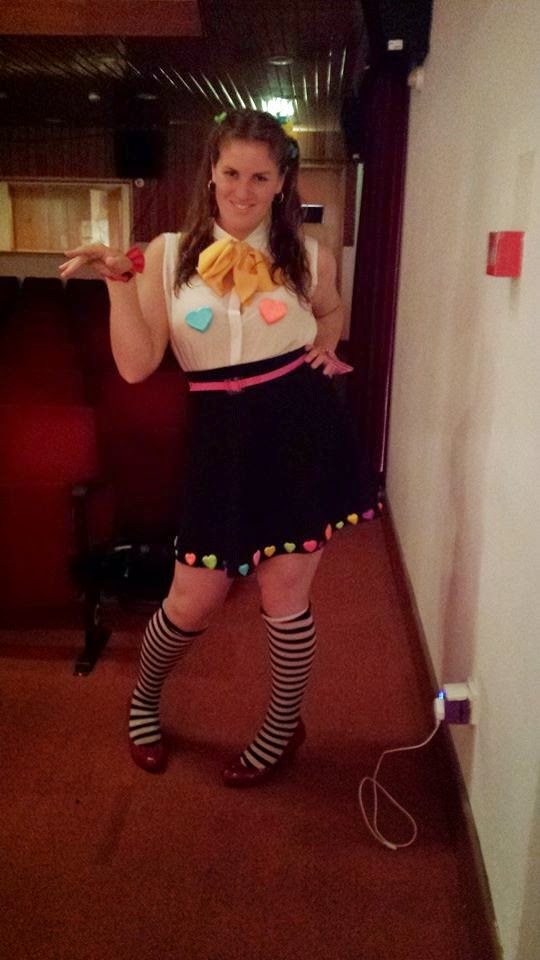
The most exciting part of the final phase of rehearsals is the addition of costumes.  Once again, my stepsisters had the most fun here.  Yes, Alidoro enjoyed playing a dirty tramp.  And Don Magnifico got some amusement out of his teddy bear and pyjamas – not to mention a particularly ridiculous wig.  But when it came to ridiculous costumes, the stepsisters definitely took the cake.  While Clorinda played a label-obsessed rich bitch, Tisbe was some sort of Britney Spears-inspired schoolgirl fantasy gone horribly wrong.  It's not so often that you hear a singer backstage hollering "has anyone seen my nipple heart?"

Tisbe's lovely costume
(I hear she's very popular in Japan.)

In comparison, my costume was what you might call… Spartan.  I got a shower cap and a paint-splattered boiler suit.  Not exactly the sexiest thing I've ever worn.  You'd have to really suspend your disbelief to think that the prince would fall instantly and madly in love with me.

In my sexy Act 1 costume with Prince Ramiro and Alidoro.

The best part of my costume was a fetching floral headdress/veil contraption which I got to wear to the ball.  It made me blind under the stage lights, and it wouldn't stay on without the help of several bobby pins, but I still loved it.

My beautiful veil for the ball

Underneath my boiler suit was the white lace dress I would wear to the ball, so that, with Alidoro's guidance, I could magically "transform" into a vision of feminine beauty.  Between this layering of costumes, the Portuguese summer heat, and the constant running around to fetch things for my stepsisters, I was in a pretty warm situation.  In fact, I can't remember sweating so much in a show since I did War and Peace, and we all had to bundle up for the Moscow winter under hot stage lights.  Every time I went backstage between scenes, I would unzip the boiler suit and start fanning myself furiously with a spare invitation to the ball.

When I wasn't recovering from the heat, I would enjoy another favourite backstage activity: dancing.

Yes, you heard me right.  While I'm waiting in the wings for my next entry, I like to get down and boogie.  The hustle, the robot, the mashed potato – you name it.  If it suits the music and the moment, I'm all over that cheesy dance move.  I know it sounds silly, but dancing backstage keeps my energy up between scenes.  It helps me stay focused, so I'm still mentally "in the show".  Sometimes if I'm lucky, I'll catch the eye of a castmate in the opposite wing and get them to crack a smile – or even to join in.

Cenerentola Gangnam style!

The second week of rehearsals also brought a first for me: my first ever stage kiss.  See, mezzos don't usually get to play the ingénue.  We're more often secondary characters – sisters, mothers, witches, or maids.  If we do get to play a love interest, it's usually a male one.  Which means kissing the soprano, not the tenor.  But even in a trouser role, I've never had the experience of kissing another singer in a show.  That is, not until I played Cenerentola.

Kissing onstage is one of the more surreal things an opera singer has to do.  It's weird enough kissing someone to which you have no romantic attachment whatsoever.  But to do it in front of an audience?  Awkwardness central.

Luckily my prince was someone I already knew well from Scotland.  It did also help that he wasn't straight – but then again, what tenor is?  Anyway, when I finally lost my stage kiss virginity it wasn't too weird or uncomfortable.  Being a seasoned stage kissing pro, my prince went in for the smooch without question.  And before I had time to get squeamish, it was all over.  Ok, so it was a bit weird when the director started critiquing our kiss and giving suggestions for angles and timing.  But I got over the weirdness after a few repetitions.  After a while it was just another piece of staging.

Thank goodness I didn't have a stage kiss like this!

As the dress rehearsal approached I developed a bit of a cold.  I was a bit worried, but not in any panic.  Luckily, although I felt a bit congested, the cold didn't seem to affect my voice.

Until it did.

The day of the dress rehearsal arrived, and I got through most of the opera without incident.  But in my final scene, my voice suddenly cut out.  I kept trying to clear my throat between phrases, hoping it was just a matter of removing some bothersome bit of phlegm.  But it was no use.  My voice had checked out, and had no intention of returning.

It was a terrifying feeling, being voiceless onstage.  I'd never experienced anything like it.  I imagine it's something like what a fish would feel like if he were swimming in open water and suddenly heard the theme from Jaws coming around the corner.  Exposed.  Helpless.  Doomed.

Uh-oh....

I finished the rehearsal marking quietly down the octave.  My final aria, which was supposed to be full of high notes and sparkling coloratura, was practically inaudible.  The performances were the very next day.  What would I do if I couldn't sing?

Over the next 24 hours, I went on a voice-saving mission.  I put myself on vocal rest, using a combination of written messages and mime to communicate with my colleagues.  I went to bed early and slept as late as possible.  And I guzzled water by the bottle-full.

ALL OF THE WATER.

The morning of the performances arrived, and I was in a real state.  I had dreamed of singing this role for so long.  I had been so excited to be cast.  I had talked about it to everyone I knew.  After all that build up, would I be able to sing the damn thing?

I arrived hours early at the theatre, intending to do a slow and careful warmup.  Instead I ended up crying in the toilets for a good half hour.  I had never felt so anxious about a performance in my life.

It took a spell on the theatre floor, practising all the deep breathing exercises known to man, but eventually I calmed down, drank more water, and began warming up in earnest.

And by some miracle, my voice was actually there.  Maybe it was all the hydration.  Maybe it was all the careful technical work I'd done singing the role into my voice.  Whatever it was, I sang through that cold.

I made it through two performances, and it all went swimmingly in the end.  Between scenes I spent a lot of time dashing to the toilets (I had drunk a LOT of water after all) and sucking on VocalZones.  But I still had time for the odd backstage boogie.  And we all had a load of fun.  Because, with Rossini, how can you not?

And they all lived happily ever after.

After such an intense work period, it's a shock to realise that the whole thing is over.  I can't help feeling a bit of the post-show blues, and wishing we could do just one more performance.  But luckily there's no time to dwell on my bel canto bereavement.  I'm already in Switzerland for the next project.  More on that soon…

Monday, 28 July 2014

The Cinderella Diaries - Part 2

So much has happened since I first arrived in Ferreira do Zêzere. Time has flown by, and we're now into the second week of staging for La Cenerentola.

The past week has been intense, to say the least.  It all began bright and early on the first day with a musical rehearsal.

The first sing-through of an opera is always a bit rough.  It takes time to get used to the other singers, to understand each other's voices and musicalities and really gel together.  And of course you want to make a good impression on the director, the conductor, and the other singers.  So at first everyone feels a bit stiff and shy.

"Wait... you want me to sing it now??"

But once the initial nerves wore off, it didn't take us long to warm to each other and really bond as an opera family.  Rossini's operas call for a lot of energy and humour.  Luckily this is something our cast has in spades.   We're a lively bunch of singers with an even livelier director, and our rehearsals have been full of belly laughs.

One thing we bonded over immediately is our astonishingly bad sense of direction.  One night after a couple of glasses of wine, I realised I had no idea how to find my way home in the dark.  My stepsisters had already left, and the women are staying in a different place than the men.  So my male colleagues, being chivalrous, decided they would help me find my way.  The only problem was that they were even worse at navigating than I was (and trust me, I'm really really bad).  Before we knew it we were hopelessly lost.  We finally gave up after an hour or so of wandering aimlessly around the Portuguese countryside.  It was almost midnight and after all, I didn't want to turn into a pumpkin.  So we headed back to the men's house and I slept on their couch.  We've got on like a house on fire ever since.

As for my stepsisters, they're as lovely offstage as they’re nasty onstage.  It's hard to pretend to be afraid of them when I know they're so sweet in real life.  Every minute they're not abusing me they're helping me up and apologising profusely for their fictional abuse.

Between the long hours of rehearsal, we like chat and relax together as we enjoy the delicious local coffee, the mouth-watering fresh fruit, and of course, my favourite Portuguese pastry, Pasteis de Nata.

The Best.

Since the first day, our staging rehearsals have moved ahead at warp speed.  Every day the director sets a goal for how many pages we'll get through, and come hell or high water we get through those pages.  Thankfully I feel very secure by now with my music.  My character, however, is another story.

Rossini's Cenerentola is a bit different from the Cinderella most of us know.  First of all she has an evil stepfather instead of a stepmother, and it's a servant of the prince instead of a fairy godmother who helps her go to the ball.  But more importantly, there are no helpful mice or magical wands to help Cenerentola find her prince.  She has to get by with her own spirit and determination.  And she doesn't accidentally leave behind a glass slipper.  She intentionally gives the prince one of her bracelets.  She tells him to come and find her.

So she's a unique kind of heroine.  On the one hand she's a victim of circumstance.  She's constantly bullied and belittled by her stepfather and stepsisters.  But on the other hand she's very strong.  She doesn't let anyone crush her spirit.  She insists on singing while she does her chores, even when her stepsisters try to stop her.  She still dreams of finding love, and even plucks up the courage to ask if she can go to the ball.  And when she arrives at the ball, she doesn't just let the prince make all the moves.  She sets her own terms: take this bracelet, come and find me.  Learn who I am before loving me.

Rossini's Cenerentola may be sweet, but she's certainly not passive.  As her feisty coloratura passages imply, she has fire in her belly.  She isn't a wet blanket or a timid little mouse.  She's a real protagonist.

The audience has to be on Cenerentola's side.  They have to want her to win.  So from the very beginning, even as she stays in the background cleaning, she has to shine with a certain kind of charisma.

Which is easier said than done.  How do I stand out as the star when I'm wearing rags and my two silly sisters are preening like peacocks in the foreground?  Even under the most ideal of circumstances, I'm not used to being the centre of attention.  How do I create my own spotlight without seeming to try?

Kid, you gotta have star quality!

I guess you could say that my diva skills are a bit rusty these days.  Since moving to Germany, I've mostly been getting work in choirs.  It's been at least six months since I've performed as a soloist, and at least a year since I've performed in an opera.

So as we began staging this week, I kept blending into the background.  Again and again my director would point out that I was turning away from the audience, or hiding behind a chair.  I didn't even realise I was doing it!  I was just so accustomed to shrinking back, being a secondary character in someone else's story.

"Oops... was I doing it again?"

One day after rehearsal, the pianist was telling me I had to give more onstage.  And I launched into a very familiar story.  I'm not a stage animal, I told him.  Acting doesn't come naturally to me.  I'm an introvert.  Despite my year at the opera studio, I still have so little experience onstage.  Other singers my age have done so many more roles.

The pianist listened to my excuses patiently.  Then gave me a puzzled look.  You're not such an introvert, he said.  Offstage, you're one of the most lively singers in our cast.  Why can't you bring that personality with you onto the stage?

......oh.

I was flabbergasted.  I had never thought of myself as lively or having a big personality.  But once I really thought about it, I had to admit that I've come out of my shell a lot in the last few years.  Yes, I am still an introvert in my own way – I still need some quiet and solitude to recharge.  But when I want to, I can be the life of the party.

So maybe it's time now to move past the old "introverted" label.  Time to embrace a new role, and take on the spotlight.

"Non piu mesta accanto al fuoco staro sola a gorgheggiar.."

With five days left until opening night, and the whole second act still to stage, we've got our work cut out for us.  The next week will either make or break me.  So it's time to step up now.  It's time to get up from the fireplace and let my inner diva shine.

Monday, 21 July 2014

The Cinderella Diaries - Part 1

I've just arrived in Ferreira do Zêzere in Portugal.  No, I’m not on holiday.  I'll be spending the next two weeks here rehearsing and performing the title role in Rossini's La Cenerentola.

This is not just any opera role.  For me, Cenerentola is a dream role.  I began learning the aria "Non piu mesta" last year at the opera studio, and I was immediately hooked.  Something about this aria just clicked for me.  It felt like home for my voice.  Comfortable but not boring.  Challenging but satisfying.  I loved the thrill of the extreme high and low notes, the rush of the coloratura, and the sweetness of the lyrical sections.  The aria became a fast favourite for me: a staple item for recitals and auditions.  And I knew that someday, somehow, I had to perform the entire role.

It was such a good fit!

So naturally I was excited to discover that the Zêzere ArtsFestival would be putting on a production of La Cenerentola this summer.  I was determined to get cast.  When I did masterclasses with my teacher in Paris, I chose to spend the week focusing on "Non piu mesta".  By the end of the week the aria was in fairly good shape.  I recorded the final performance and sent it to the festival, asking to be considered for the role.

A few months later I received the email: I had been cast as Cenerentola!  Needless to say, I was thrilled.  After all, what girl doesn’t dream of being Cinderella, if only once in her life?

Bibbity bobbity boo!

Of course, it wasn't just the glamour that appealed to me – I knew it would also be a great learning opportunity.  Since graduating from the opera studio, I had only been able to find concert work, and after months of "parking and barking" I was chomping at the bit for the chance to sing opera again.  I would be able to learn and perform major role in the standard repertoire – and one which suited my voice very well.  In short, it was a dream come true.  I got the score and immediately set to work.

Learning a role can be a rather long and tedious process. It's the boring side of opera – the unglamorous grunt work which the audience never sees.  First there is the task of simply learning all the dots.  You spend countless hours studying the score in every possible way.  Bashing out notes at the piano, listening to recordings, and toting the score around to countless cafes, buses, airports and libraries for silent study.  If you have a substantial enough sized role to learn, as Cenerentola is, after a while the score becomes something like an extra limb.  It just automatically goes with you everywhere.

Of course, some days you take a more passive approach to score study...

After you've learned the notes, you of course need time to sing everything in: to practise the role technically and musically, and really get it "into your voice."  Here is where trusted teachers and coaches step in – to lend a second pair of ears and help you sound stylish and polished.

But all this is just the first phase of learning a role.  Because after all, opera is performed from memory.  Singers are expected to show up to the first day of staging knowing everything from heart.  To get to this point, you can’t just know the notes.  You can’t just have it "in your voice".  You have to really get the role under your skin.  And there’s only one way to do that: repetition, repetition, and more repetition.

This is the point where you start to go a bit mad.  You sing bits of recit to yourself while washing dishes, waiting for the bus, or chopping vegetables.  You mutter your text to yourself as you ride the train or walk down the street.  Inevitably, people think you're a bit crazy.  After a while, you get used to receiving weird stares from passersby because, without realising it, you were just muttering through that tricky bit of the duet.

When I first looked at the score for La Cenerentola, it was a bit like staring up Mount Everest.  Surely the task was unsurmountable!  How would I ever learn to sing all those notes, not just accurately, but with elegance and style, and from memory?  How would I ever know so much music so thoroughly that I'd be able to sing it all under pressure, in front of an audience, while following complicated staging?  But of course I knew it wasn't impossible.  I just had to keep chipping away at it, and eventually everything would become second nature.

I will conquer you, Everest!

Learning La Cenerentola has had its own unique challenges.  Some of these I was prepared for, and some came as a total surprise.  Of course, having sung the aria, I knew there would be a lot of coloratura and high notes.  Not a big problem per se – that’s the kind of thing my voice does rather well.  But when I looked at the full score, I was confronted with an unexpected enemy.  Patter.  Lots and lots of patter.

For the uninitiated among you, patter is the art of singing lots of words very very fast.  The most well-known examples of this are Figaro's opening aria in The Barber of Seville, or the Gilbert and Sullivan classic Modern Major General.  La Cenerentola is chock-full of patter – sections where you have to rattle off a series of tongue-twisting Italian words at a million miles a minute.

Learning the patter was a big task for my brain, as well as my teeth, tongue, and lips.  There was no way around it but to spend hours speaking the words to myself, over and over, getting gradually faster until it became automatic.  Even when I knew the words well, I often found myself stumbling over the syllables.  There was just so much coordination involved!  Everything had to keep clicking forward like a well-oiled machine.  If I let my mind stall just a millisecond too long, or involved my jaw too much in the articulation, I was done for.  The words flew by and I was left behind.

Just keep going, just keep going...

All of this meant that I most definitely got used to looking like a crazy person.  I needed to get the text into my muscle memory.  And so I would spend every spare moment speaking the patter to myself, wrapping my tongue around the syllables and familiarising my lips with their unique shape and order.  To anyone who has seen me wandering around talking to myself in Italian over the last couple of months, please accept my apology.  I'm not crazy, I swear.  I'm just an opera singer.

The last couple of months leading up to my arrival in Portugal, I've had my share of ups and downs.  At times it's been a struggle to fit my role study between travel and rehearsal schedules for other gigs.  And with my recent health problems, there were times I was worried I wouldn't be able to move onstage at all!  But just like a fairytale, everything has come together in the end.  I've found time to practise and prepare everything, and also managed to get some good lessons and coachings on the role.  And thanks to a combination of medication, physiotherapy, and one very sexy-looking knee support, I'm now able to move naturally and without pain.  So here I am, at the ball and ready to dance.  I can’t wait to get started!

Tuesday, 10 September 2013

On finding your own way...

Life after graduation.  The great beyond.  How do we visualise it?  And how does reality measure up?  If you're anything like me, as a young singer you pictured some kind of fairytale ending, where all of your hard work and diligence would be rewarded with a contract, an agent, or a coveted place in a prestigious young artist programme.  You thought that if you worked hard enough, did all the right things, auditioned for all the right people, eventually someone would hand you a career on a silver platter.

"Your career, ma'am - careful, it's piping hot"
As an undergrad student, I used to look at singers in the opera school with great reverence.  I heard their glorious voices and I expected great things of them.  I was often shocked and disappointed when they didn't live up to my expectations.  "What do you mean you're still living with your parents," I might say, "aren't you supposed to be singing at the Met by now?"  I remember seeing older singers, singers with masters degrees and years of training, singers with heaps of talent and ambition - and they were still struggling to survive.  Secretly I thought to myself, they must be doing something wrong.  That won't be me.

As the years rolled by, I lost some of my high hopes and naïveté.  I saw how competitive it was in the music world.  I learned that it took most people several years to build a career, and that even the most talented singer might struggle just to make a living.  And yet, in my heart of hearts, I still hoped that I would be different.  I would be special.

I think that deep down inside, I believed the world was a fair and logical place.  If you put in enough work, you reap the rewards - simple.  And so as I began my year at the opera studio, I didn't worry too much about the future.  I would audition for as many things as possible, and surely at one point someone would give me an obvious answer.  Someone would offer me an opportunity, and my future would be all mapped out.

"Follow me - your career goes that way!"
But the truth is, for most of us it's not so straightforward.  Yes, there are people who win contracts right out of school and transition smoothly into a singing career.  But those people are the exception to the rule.  Most of us finish school with a blank page and no idea how to fill it.  We have to find our own way.

It was around springtime this year when I realised that no one was going to offer me any easy answers.  I hadn't won a place in any young artist programmes, and no agents or opera companies had signed me on.  The future was a big blank.  I was all by myself.

My immediate reaction was panic and despair.  I couldn't believe that after all my hard work this year, all the progress I had made on my voice and my acting, nobody was going to scoop me up and take care of me.  How was I going to make a living?  Where was I going to live?  What was the next step?  How would I know if I was doing the right thing?

I'm not so good at making decisions.
Nonetheless, bit by bit, I started to ask myself some questions.  What kind of music did I want to sing?  Who did I want to sing it with?  What kind of life did I want to have?  And eventually the answer became clear to me.  In fact, it had been staring me in the face the whole time.  I wanted to move to Germany.

I have been thinking about moving to Germany for a long time.  And yet I've always been afraid to take the leap.  Perhaps because the prospect of a foreign language daunted me.  Perhaps because it seemed unoriginal - so many other young singers had done it before me.  Or perhaps because I had heard horror stories of singers arriving in Germany full of hopes and dreams, only to leave a few months later with an empty wallet and their tails between their legs.

But I had a few advantages over those singers in the horror stories.  First of all, I already knew some German.  Secondly - miraculously - one of my auditions this year had actually paid off, and I had some choir work lined up in Stuttgart.  It wasn't much, but it would pay the rent, which was a good start.

After ordering a refresher audio course online (I hadn't studied any German since undergrad, which was - *cringe* - almost 10 years ago) I started thinking about where exactly in Germany I would live.  Eventually I settled on Cologne.

Why Cologne?  It wasn't exactly a scientifically calculated choice.  I could have easily decided to move to any German city.  But I did consider a few factors in my decision: cost of living, accessibility, and proximity to Stuttgart.  Cologne is close to 3 major airports, and is only a few hours away from Stuttgart by train.  It's also pretty close to Gent, meaning it would be easy to come back to Belgium for work or visiting friends.  Compared to most major German cities, it's not an expensive place to live.  And, most helpful of all, I already had a couple of friends living there.  In other words, I wouldn't be completely alone when I arrived.

"Hello?..... Anybody there???"
It's a scary prospect, this move to Cologne.  I've moved country before (twice), but both times I was landing safe and sound in a postgraduate course, where I would have a readymade group of peers and a schedule of classes to follow.  This time, apart from the bit of choir work, I have no idea what will happen in the next few months.  My only plan is to find a flat, take German classes, and start auditioning.  The future is one big question mark.  Anything could happen.

And yet, there's something thrilling about this question mark.  It's a blank canvas which I have the power to fill however I like.  I don't have to follow someone else's path.  I can make a new one.  I'm my own boss, in control of my own destiny.

I know these next few months will be scary, difficult, confusing, and often lonely.  But they are also an opportunity to make my own career, in my own way, tailored to a shape and size that suits me.

"Yep, this career will fit my voice perfectly."
So often we singers are seduced by the career paths which have been prescribed to us.  We pressure ourselves to get into this opera school or that young artist programme, and we beat ourselves up when we don't.  We never seem to stop and think, is this really good for me, or is it just what I've been told is good for me?  What if other people's idea of success is not your true calling?  What if there are other ways, other paths, which might be better for you, which might ultimately make you happier?  You'll never find out unless you look.

I have many friends whose career paths don't fit into the preconceived notion of a budding young opera star.  They are successful freelance singers, and so much more.  They are educators, directors, administrators, writers, conductors, coaches, and founders of brand new ensembles and opera companies.  Are they living the life they envisioned for themselves?  No.  They are living something far more interesting than they ever could have imagined.

Life after graduation is hard.  Whatever our dreams are, however hard we work for them, most of us don't transfer seamlessly into our ideal career.  But what we do achieve can be so much more exciting.  With creativity, determination, resourcefulness and vision, we forge ahead.  We find our own path, and we're often delighted to discover where it leads.

Here I am, foot poised, about to start out on my own path.  And I can't wait to find out what comes next.


Friday, 31 August 2012

On chasing your dreams...

I’m going to get a little bit corny here.  Bear with me.

I’d like to talk about the importance of chasing your dreams.
I’m about to embark on a new adventure, and I’d like to use this first post to write about how I got to this point.  It was a strange and twisted path, full of unexpected turns…

Now this is the story all about how my life got flipped, turned upside down, and I'd like to take a moment, just sit right there...
Two years ago I finished a postgraduate singing course in Glasgow, and emerged squinting and blinking into the harsh light of the real world.  I was chock-full of hubris, naivety, and pure bald-faced hope.  Sure, I’d seen other graduates struggling when they got out of school, but somehow I thought it would be different for me.  Of course, having spent the last seven years in music college I had only a vague and fuzzy idea of how the music industry worked.  But people told me I was a promising young singer with a great career ahead of me, so I (stupidly) believed them, and I kind of expected that this great career would just, like… happen.  (I know this must sound totally ridiculous, but I think that if we’re being perfectly honest here, deep down inside, a lot of music college graduates feel this way).

Of course I didn’t think this career was going to land magically in my lap!  I had to go out there and do auditions.  So I started sending out CVs and doing audition after audition after audition.  And getting rejection after rejection after… well, you get the picture.  Sure, some people were nice about it (“The competition was REALLY tough this year” … “We’ll call you if anything changes”) but when it came down to it, they were all saying no.  It was like a big slap in the face.  This whole real world thing really sucked. 
Life is just so hard when you're tenderhearted and full of dreams...
Then my boyfriend broke up with me.

And what followed was – I’m not exaggerating here – possibly the worst week of my life.  Having just been dumped, I went to London for an intensive week of auditions.  The first audition went badly, and I lost some confidence, which made the next audition go worse, which made me lose more confidence, and so on and so on.  It was a horrible downward spiral of insecurity and terror.  Again, not exaggerating.  You know when you sweep the floor, and you get this ugly little ball of hair and dust and gunk, and you flush it down the toilet?  Well that was kind of what this looked like.

-She doesn't get eaten by the eels at this time
-What?
-The eel doesn't get her. I'm explaining to you because you look nervous
I was pretty much crushed to a pulp at this point, and I was ready to pack up and go home and vow never to sing again, when I got a phone-call that changed my life.

No, it wasn’t a singing job, and it wasn’t my boyfriend asking me to take him back.  Come on people, this is not a fairytale or a romantic comedy, it’s my life!

But it was the next best thing that could have happened to me at this point.  It was an offer for a job in arts administration.

It’s a sign, I thought!  I was never meant to be a singer, I was meant to have a career in arts administration!  This is my destiny calling!  So, after going home for Christmas and spending a couple of weeks crying into my pillow about the breakup (it had to be done) I started my new job with new-found hope for the future.

Me on my first day of work.
At first I loved it.  After all, arts administration is a challenging, rewarding, and often exciting field to work in.  Unlike all the hours I spent in the practice room, the hours I spent in the office had real, tangible results.  And for once it was actually a GOOD thing to be a detail-oriented perfectionist (trust me, this is not a good thing when you’re a singer – if anything it’s a handicap).

But after a while, a funny thing happened.  I started to get singing work.  Nothing earth-shattering of course, but the work started to pick up, and I began to make a modest name in the concert circuit.  And I started to remember how much I loved singing.

Then another funny thing happened.  I started to get restless.

See, everyone tells you that you should chase your dreams.  What they don’t tell you is that sometimes, when you ignore them, your dreams start to chase you.  I liked my job, and some days I even loved it, but it was not what I had been dreaming of ever since I was a little girl.  And I could only spend so long denying what I really wanted to do.  Over the next few months I gradually transitioned from being an arts administrator who did some singing on the side, to being a singer who worked in arts administration to pay the bills.

I wanted mooooooore....

I decided that I had to give this singing lark another go.  I would really go for it this time – practise super-hard and audition for as many things as possible – and if after all that I still hadn’t got anywhere, well then I would be able to give up properly, because I would know that I had really tried my best and it just wasn’t meant to be.
I worked very hard over the next few months.  I practised on my lunch hours and on weekends, and scheduled coachings and rehearsals after work.  I had another unsuccessful audition, but this time I reacted differently.  So what, I thought.  So a couple of guys happen not to like my singing?  Someone else will.  Somewhere out there, I am what they’re looking for.  I went for more auditions, this time in Europe.  These auditions had some more encouraging results.  For one opera course I made it through to the second round with 12 other singers, but wasn’t offered one of the 5 available places.  For another course I was put on the reserve list.

So I had a choice at this point.  I could give up, or I could decide this meant I was getting closer and try again.
Hmmmm....
Actually, to be perfectly honest, I did neither.  I moped.  I despaired and cried, and told anyone who would listen about how Life Is Just Not Fair.  But somewhere amidst the haze of my self-pity I started formulating a plan B.  I would go to Germany.  I would stay with my relatives in Berlin and do more auditions.  I would apply for jobs with professional choirs, and find a teacher, and just keep trying.

And just as I started to look at job advertisements in Das Orchester, I got another life-changing phone-call.  Remember that reserve list?  Well, a place had opened up in the course.

So here I am now, about to move to Belgium to join an opera studio in Ghent.  And you know what?  I’m really glad things have happened this way.  I wouldn’t trade in a single moment of all that agonising and self-doubt.  Because in the end, it convinced me exactly how much I want this.  There were a lot of times when I almost gave up, and there will probably be a lot more times like that – but the important thing is that I didn’t.  And I won’t.  Because some dreams can’t be ignored.  Some dreams need to be chased all the way.