Showing posts with label Confidence. Show all posts

Sunday, 5 July 2015

On signing the contract...

Another season is coming to its close, and, as my friend has been saying, change is in the air.  It seems these days almost everyone I know is on the move.  Some are going away to study, some are beginning new jobs, and some have won places in young artist programmes.

As for me, I am preparing for my fourth move in six years – and this time, my new home will be Austria.  I've just signed a two-year contract with the opera chorus in Innsbruck. 

My shiny new workplace

In a way, this turn of events has felt very sudden.  In another way, I sensed for a while now that it was going to happen.

You may have noticed I've been blogging a lot less lately.  The fact is, I've been too busy singing!  In the past six months or so, things really began to cook, and I had a very full calendar.  Lots of projects, lots of travel, and lots of performing.  It would seem, as a freelancer, I was doing pretty well.  Some people might even go far as to call me successful.

There's just one thing.  And I feel like I’m committing some kind of cardinal sin by saying this.  But here it is: freelancing made me unhappy.

I was exhausted by the constant travel.  I hated being away so much, and never feeling like I had a steady home base.  I was sick of airports and hotel rooms.  I worried constantly about money.  And I really struggled with the extreme emotional highs and lows.  Performances could make me feel on top of the world – but as soon as a project was over, I would crash into a post-performance slump, and feel like it was impossible to recover.

"Help!  I've fallen and I can't get up!"

I felt bad complaining, because I knew I should feel lucky to be making a living doing what I loved.  I knew some people might even see the work I had, the places I was seeing, and feel jealous.  I didn't want to seem ungrateful, or come across like I was having "first world problems".  But the truth is, freelancing made me feel anxious and exhausted all the time.

Some people love freelancing.  They love the adrenaline and excitement, the novelty of exploring new cities and working with new colleagues, the feeling of being a free agent and answering to nobody.   I have friends who thrive on the freelance life, and it's a beautiful thing to behold.  As for me, I've never managed to get past the feeling that I'm barely coping, struggling to survive.  It has never felt like a safe or sustainable way to live.


As my calendar got fuller and my "success" continued, I felt like the walls were closing in on me.  Something had to give.  Something had to change.  And then it did.

As I went from project to project, I continued to do auditions.   Nothing new there.  I've been doing auditions since I arrived in Germany.  It's become a predictable sort of routine.  I get invited, I prepare, I travel, I sing, and they say no.  Rinse and repeat.  The no's get less shocking every time.  I know it sounds twisted, but I've actually come to expect them.  I sigh, shrug my shoulders, pick myself up and start preparing for the next audition.  That's just the way it goes.  As it was, is, and ever shall be, world without end Amen.

But as I continued to audition, some small, almost imperceptible adjustments were taking place.  My German was improving.  I was settling into a more comfortable, confident attitude with audition panels.  I was more relaxed.  I felt more like myself.  I even began to – shock, horror – crack the occasional joke!

Perhaps most importantly, I was always busy with work.  Which meant that I was too busy to overprepare, overthink, or put too much pressure on myself to succeed in any one audition.  I had just enough time to practise my arias and sing them for the panel.  No more, no less.  In short, I stopped caring so much.


One day, I went to sing for a government agency in Stuttgart.  I had already sung for this agent a year ago, and it was completely fruitless, so I wasn't expecting anything.  To my surprise, they took me on, and immediately started advising me on some upcoming jobs.

I didn't really know how to react.  They said… yes?  That couldn't be right.  Surely it was some kind of mistake?

Who, me?

Once I got over the initial shock, I realised that, somehow, I must be doing something right.  I decided to keep the momentum going and audition immediately for the government agency in Cologne as well.  This time, the agent told me there was a job I'd be perfect for.  Could I audition in Innsbruck before the end of the June?  The next day the theatre phoned and asked when I could come and sing.

I couldn't believe it!  It seemed like everything was happening so quickly, so easily.  I was so used to hearing "no".  I was so used to struggling for everything.  Now suddenly I had taken a turn, and everything was falling effortlessly into place.  "Well," said my singing teacher, "it sounds like the universe is telling you that you're on the right path."

"That's right, this way, just keep going!"

Sure enough, a week later I found myself at the theatre in Innsbruck.  The audition went well, and they hired me on the spot!

This all happened over a month ago, and it still feels pretty surreal.  I've since signed a contract, had my first costume fitting, found an apartment in Innsbruck, and applied for my Austrian visa.  I've also gone through the business of informing employers and colleagues, and cancelling other upcoming work.  And yet no matter how many people I tell, somehow I still can't believe it.

Change is in the air, as my friend says.  And this change is a big one.  I'm still struggling to wrap my head around it.  Not only because I'm moving to a new country.  Not only because my fiancé and I will – once again – have to adjust to a long-distance relationship.  In fact, the very idea of having a job is blowing my mind.  It seems as if the whole definition and purpose of my life has changed.

For as long as I can remember, I've been practising so that I can perform well in auditions and win a job.  That was always my focus, my motivation, my raison d’être.  Now suddenly, I've got that job.  It's everything I've been working towards.  I'm finally safe, and I know I'll be able to stay in one place and receive a monthly salary for my work.

Strangely enough, as much as I’m happy and relieved by all this, it's also opening up some deep existential questions.  What do I sing?  Why do I sing?  Why do I exist, if not to work towards the next big audition?  What can I strive towards, what can I struggle with, now that this big question mark has been removed from my life?  How will it feel, no longer living on the edge?  Who is Diva on a Dare, when she's no longer Daring?


As I prepare to begin this new phase of life, I'm looking forward to more security, more stability, a better quality of life.  I'm sure I will feel much happier and healthier than I ever did as a freelancer.  I'm also sure that I have some soul-searching ahead of me.  It's time to discover who I really am, and why I really sing.  Once I stop struggling to survive, once I remove this relentless worry about what-comes-next… what will remain?

I can't wait to find out.

Sunday, 29 March 2015

On learning a foreign language (Part 2)

It's been a year and a half now since I last wrote about learning a foreign language.  A lot has changed since then.  I'm starting to get the hang of this German business now, and for the most part I get by.  I'm certainly nowhere close to being fluent, but somehow I am managing to function every day auf Deutsch.

Of course, it does help that I finally sucked it up and hit the books.  Last spring I signed up for an intensive B1 course at the Volkshochschule in Cologne.  (For those of you not in the know, the Volkshochschule is a German institute for adult education: a much more affordable route for learning German than Berlitz or the Goethe Institute, although you won't get any official accreditation).  The course gave my German skills a major boost.  The biggest difference I noticed was my grammar.  Before taking the course I would often just throw random words together into a sentence, and pray it made some kind of sense.  Now I'm much more conscious of things like cases and word order.  The rules haven't yet become automatic, but at least now I think about them and try to correct myself.

I have progressed.  Really, I have.  And people are noticing.  But no matter how good my German gets, it never feels real.  The truth is, most days I feel like a big fat fraud.  It's like I'm putting on an act for everyone.  I don't really speak German – I'm just playing the role of someone who does.  I'm constantly acting, pretending, struggling to "pass" – and hoping that people won't see right through me.

There are days I'm so sure that someone will turn around and call my bluff.  "YOU don’t belong here!" they'll say.  "You don't REALLY speak German!"

"RAUS, du Lügner!!!"

I always knew learning a new language would be an intellectual challenge.  What I wasn't prepared for was the emotional challenge.  The feeling that you never really fit in, and you never really know what's going on.  The frustration that comes with being unable to express yourself fully or accurately.  The intense homesickness of missing your native language.  The loneliness and isolation that comes with realising you're the only person in the room who speaks it.

All of the feels.

When I first moved to Germany, I used to play it safe.  Surround myself with English speakers, and only speak German when it was absolutely necessary.  It was like I had this safe little English bubble to float around in.

Lalalala.... bubbling around...

But I couldn't stay in this bubble forever.  After all, I wouldn't always have English-speaking colleagues around.  More and more, I began to find myself in situations where nobody else spoke English.  It was overwhelming, and it scared me half to death.  But it left me with no choice.  I had to sink or swim.  If I wanted to survive, I would have to do it auf Deutsch.

How can I explain the discomfort of constantly speaking a language which isn't your own?  It's like an extra layer of challenge has been added to every single part of your day.  Imagine if you could never see things clearly, but instead had to peer through a screen all the time.  You never get a full picture of reality.  You're always squinting and craning your neck, trying to piece together what on earth is going on from what you can – just barely – see.  That's what it feels like speaking German every day.  Some days the screen obscures a lot, and sometimes it's more transparent.  But make no mistake, the screen is always there.

"It looks like... they're saying something.. about..... a bicycle?"

Perhaps the most difficult thing is that, in German, I can't really be myself.  I'm far too self-conscious and slow on the uptake.  I must seem like the most boring person in the world in German.  I hardly say a word aside from "ja" or "stimmt".  Usually by the time I've understood someone and formulated a response, they've moved on to another subject entirely.

One-on-one conversations are fine, because my conversation partner can always slow to my pace.  But group situations are the absolute worst.  As the talk gets lively, everyone starts talking a mile a minute and interrupting each other.  Meanwhile I'm sitting in silence, looking for all the world like a dull and humourless idiot.  It probably seems like I have no thoughts or ideas in my head at all.  The truth is that my head couldn't be busier!  While everyone else is nattering on, I'm making a bunch of complicated linguistic calculations and mental back-flips just to get a basic grasp of what they're talking about.

So much.... translating....

Any friend of mine can attest to the instant transformation I undergo when I switch from German to English.  As I move to my native tongue, all hesitations fall away, and my true self emerges.  One minute I'm dull as dishwater, and the next minute I'm the life of the party.  Hey, who knew it?  Turns out this girl actually has a personality!

For this reason, I still socialise a lot in English.  Most of my friends are other native English speakers, or Germans with very good English (there's a lot of those).  I may be able to make small talk and friendly chat in German, but this always comes with a certain level of awkwardness, and a lingering feeling that I'm doing my math homework.  It's one thing to go through this effort when I'm on the clock, but why would I want it in my down-time?  Only in English can I truly relax.  Only in English can I feel natural, and be myself without worrying about whether I just used the right pronoun.

"Ahhhh.... this is the life."

And so a real dichotomy has developed.  German is my work language, and English is my leisure language.  It's like I put on a German hat to go to work, and take it off as soon as I get home.

I often wonder when this language will become second nature.  When will I be truly fluent?  When will I speak German with bravado and ease?  When will I form a sentence without thinking, is it der, die, or das?

Years later, Joe still wonders if it was "die Birne" after all

One sure sign will be the day I have a real German friend.  I'm not talking about a German friend who speaks English with me.  I'm not talking about a friend-ly German, who speaks simple German with me so we can make superficial chitchat.  I'm talking about a German who speaks to me in German consistently, using sophisticated language, and discusses deep and important issues.  I'm talking about someone who can be real with me in their language, and not have to constantly worry about dumbing things down.  If I can reach that level of understanding with a native German speaker, I'll know I've really made it.

But I have to be patient.  Learning another language is a slow process, and nobody becomes fluent overnight.  It takes years of repetition, immersion, and trial and error.  Sometimes your progress can be so slow it's imperceptible – and other times you'll make a huge leap and completely surprise yourself.  It will be years before I can feel completely comfortable in German.  In the meantime I'll have to be kind to myself, and trust that I'm moving forward.

Wednesday, 6 August 2014

The Cinderella Diaries - Part 3

It's hard to believe that our production of La Cenerentola is over.  The past two weeks have flown by in a blur.  And at the same time they've contained an eternity.

In the second week, our rehearsals began to pick up momentum.  We finished staging within two days, and it was an enormous relief to know that the entire opera was now blocked.  After revising a few scenes – reducing the overall levels of faffage – we began to do run-throughs.  It was so satisfying to see the show come together in its entirety.  We had spent so long fussing over little bits and pieces, and now we finally began to see the fruits of our labour.  The opera started to make some sort of sense.

Of course, being Rossini, it didn't really make sense at all.  The whole production was extremely silly in the best possible way – full of slapstick gags and physical comedy.  Most of this was carried out by my two stepsisters, who strutted about and slapped me around and bickered over their shopping bags.  I have to admit, I envied my sisters in a way.  They may not have had the most beautiful phrases to sing, but they certainly got to have the most fun onstage.

Clorinda struts her stuff.

At first I was pretty anxious about the whole physical comedy thing.  It's not that I didn't love the idea in principle.  I just wasn't sure my body would be up for the job.  My knee was still in poor shape, and while I was wearing my incredibly attractive knee support to every rehearsal, some movements were still pretty tricky.  But with time I gained fitness and confidence, and was amazed and relieved to discover that I could run, crouch, lift heavy objects, and even fall to my knees.  As rehearsals went on I slowly weaned myself off of my knee support, knowing I wouldn't be able to wear it in performance.  And it was all ok in the end.

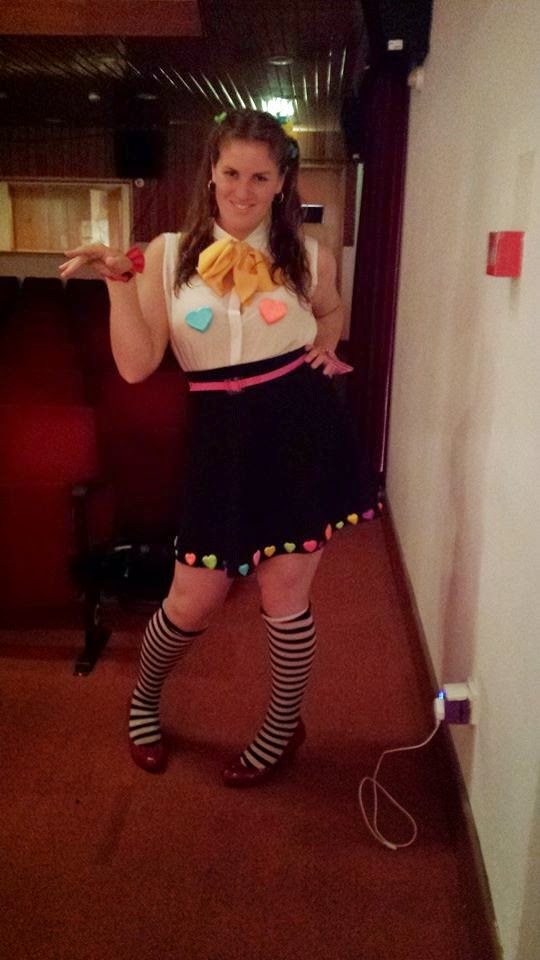
The most exciting part of the final phase of rehearsals is the addition of costumes.  Once again, my stepsisters had the most fun here.  Yes, Alidoro enjoyed playing a dirty tramp.  And Don Magnifico got some amusement out of his teddy bear and pyjamas – not to mention a particularly ridiculous wig.  But when it came to ridiculous costumes, the stepsisters definitely took the cake.  While Clorinda played a label-obsessed rich bitch, Tisbe was some sort of Britney Spears-inspired schoolgirl fantasy gone horribly wrong.  It's not so often that you hear a singer backstage hollering "has anyone seen my nipple heart?"

Tisbe's lovely costume
(I hear she's very popular in Japan.)

In comparison, my costume was what you might call… Spartan.  I got a shower cap and a paint-splattered boiler suit.  Not exactly the sexiest thing I've ever worn.  You'd have to really suspend your disbelief to think that the prince would fall instantly and madly in love with me.

In my sexy Act 1 costume with Prince Ramiro and Alidoro.

The best part of my costume was a fetching floral headdress/veil contraption which I got to wear to the ball.  It made me blind under the stage lights, and it wouldn't stay on without the help of several bobby pins, but I still loved it.

My beautiful veil for the ball

Underneath my boiler suit was the white lace dress I would wear to the ball, so that, with Alidoro's guidance, I could magically "transform" into a vision of feminine beauty.  Between this layering of costumes, the Portuguese summer heat, and the constant running around to fetch things for my stepsisters, I was in a pretty warm situation.  In fact, I can't remember sweating so much in a show since I did War and Peace, and we all had to bundle up for the Moscow winter under hot stage lights.  Every time I went backstage between scenes, I would unzip the boiler suit and start fanning myself furiously with a spare invitation to the ball.

When I wasn't recovering from the heat, I would enjoy another favourite backstage activity: dancing.

Yes, you heard me right.  While I'm waiting in the wings for my next entry, I like to get down and boogie.  The hustle, the robot, the mashed potato – you name it.  If it suits the music and the moment, I'm all over that cheesy dance move.  I know it sounds silly, but dancing backstage keeps my energy up between scenes.  It helps me stay focused, so I'm still mentally "in the show".  Sometimes if I'm lucky, I'll catch the eye of a castmate in the opposite wing and get them to crack a smile – or even to join in.

Cenerentola Gangnam style!

The second week of rehearsals also brought a first for me: my first ever stage kiss.  See, mezzos don't usually get to play the ingénue.  We're more often secondary characters – sisters, mothers, witches, or maids.  If we do get to play a love interest, it's usually a male one.  Which means kissing the soprano, not the tenor.  But even in a trouser role, I've never had the experience of kissing another singer in a show.  That is, not until I played Cenerentola.

Kissing onstage is one of the more surreal things an opera singer has to do.  It's weird enough kissing someone to which you have no romantic attachment whatsoever.  But to do it in front of an audience?  Awkwardness central.

Luckily my prince was someone I already knew well from Scotland.  It did also help that he wasn't straight – but then again, what tenor is?  Anyway, when I finally lost my stage kiss virginity it wasn't too weird or uncomfortable.  Being a seasoned stage kissing pro, my prince went in for the smooch without question.  And before I had time to get squeamish, it was all over.  Ok, so it was a bit weird when the director started critiquing our kiss and giving suggestions for angles and timing.  But I got over the weirdness after a few repetitions.  After a while it was just another piece of staging.

Thank goodness I didn't have a stage kiss like this!

As the dress rehearsal approached I developed a bit of a cold.  I was a bit worried, but not in any panic.  Luckily, although I felt a bit congested, the cold didn't seem to affect my voice.

Until it did.

The day of the dress rehearsal arrived, and I got through most of the opera without incident.  But in my final scene, my voice suddenly cut out.  I kept trying to clear my throat between phrases, hoping it was just a matter of removing some bothersome bit of phlegm.  But it was no use.  My voice had checked out, and had no intention of returning.

It was a terrifying feeling, being voiceless onstage.  I'd never experienced anything like it.  I imagine it's something like what a fish would feel like if he were swimming in open water and suddenly heard the theme from Jaws coming around the corner.  Exposed.  Helpless.  Doomed.

Uh-oh....

I finished the rehearsal marking quietly down the octave.  My final aria, which was supposed to be full of high notes and sparkling coloratura, was practically inaudible.  The performances were the very next day.  What would I do if I couldn't sing?

Over the next 24 hours, I went on a voice-saving mission.  I put myself on vocal rest, using a combination of written messages and mime to communicate with my colleagues.  I went to bed early and slept as late as possible.  And I guzzled water by the bottle-full.

ALL OF THE WATER.

The morning of the performances arrived, and I was in a real state.  I had dreamed of singing this role for so long.  I had been so excited to be cast.  I had talked about it to everyone I knew.  After all that build up, would I be able to sing the damn thing?

I arrived hours early at the theatre, intending to do a slow and careful warmup.  Instead I ended up crying in the toilets for a good half hour.  I had never felt so anxious about a performance in my life.

It took a spell on the theatre floor, practising all the deep breathing exercises known to man, but eventually I calmed down, drank more water, and began warming up in earnest.

And by some miracle, my voice was actually there.  Maybe it was all the hydration.  Maybe it was all the careful technical work I'd done singing the role into my voice.  Whatever it was, I sang through that cold.

I made it through two performances, and it all went swimmingly in the end.  Between scenes I spent a lot of time dashing to the toilets (I had drunk a LOT of water after all) and sucking on VocalZones.  But I still had time for the odd backstage boogie.  And we all had a load of fun.  Because, with Rossini, how can you not?

And they all lived happily ever after.

After such an intense work period, it's a shock to realise that the whole thing is over.  I can't help feeling a bit of the post-show blues, and wishing we could do just one more performance.  But luckily there's no time to dwell on my bel canto bereavement.  I'm already in Switzerland for the next project.  More on that soon…

Monday, 28 July 2014

The Cinderella Diaries - Part 2

So much has happened since I first arrived in Ferreira do Zêzere. Time has flown by, and we're now into the second week of staging for La Cenerentola.

The past week has been intense, to say the least.  It all began bright and early on the first day with a musical rehearsal.

The first sing-through of an opera is always a bit rough.  It takes time to get used to the other singers, to understand each other's voices and musicalities and really gel together.  And of course you want to make a good impression on the director, the conductor, and the other singers.  So at first everyone feels a bit stiff and shy.

"Wait... you want me to sing it now??"

But once the initial nerves wore off, it didn't take us long to warm to each other and really bond as an opera family.  Rossini's operas call for a lot of energy and humour.  Luckily this is something our cast has in spades.   We're a lively bunch of singers with an even livelier director, and our rehearsals have been full of belly laughs.

One thing we bonded over immediately is our astonishingly bad sense of direction.  One night after a couple of glasses of wine, I realised I had no idea how to find my way home in the dark.  My stepsisters had already left, and the women are staying in a different place than the men.  So my male colleagues, being chivalrous, decided they would help me find my way.  The only problem was that they were even worse at navigating than I was (and trust me, I'm really really bad).  Before we knew it we were hopelessly lost.  We finally gave up after an hour or so of wandering aimlessly around the Portuguese countryside.  It was almost midnight and after all, I didn't want to turn into a pumpkin.  So we headed back to the men's house and I slept on their couch.  We've got on like a house on fire ever since.

As for my stepsisters, they're as lovely offstage as they’re nasty onstage.  It's hard to pretend to be afraid of them when I know they're so sweet in real life.  Every minute they're not abusing me they're helping me up and apologising profusely for their fictional abuse.

Between the long hours of rehearsal, we like chat and relax together as we enjoy the delicious local coffee, the mouth-watering fresh fruit, and of course, my favourite Portuguese pastry, Pasteis de Nata.

The Best.

Since the first day, our staging rehearsals have moved ahead at warp speed.  Every day the director sets a goal for how many pages we'll get through, and come hell or high water we get through those pages.  Thankfully I feel very secure by now with my music.  My character, however, is another story.

Rossini's Cenerentola is a bit different from the Cinderella most of us know.  First of all she has an evil stepfather instead of a stepmother, and it's a servant of the prince instead of a fairy godmother who helps her go to the ball.  But more importantly, there are no helpful mice or magical wands to help Cenerentola find her prince.  She has to get by with her own spirit and determination.  And she doesn't accidentally leave behind a glass slipper.  She intentionally gives the prince one of her bracelets.  She tells him to come and find her.

So she's a unique kind of heroine.  On the one hand she's a victim of circumstance.  She's constantly bullied and belittled by her stepfather and stepsisters.  But on the other hand she's very strong.  She doesn't let anyone crush her spirit.  She insists on singing while she does her chores, even when her stepsisters try to stop her.  She still dreams of finding love, and even plucks up the courage to ask if she can go to the ball.  And when she arrives at the ball, she doesn't just let the prince make all the moves.  She sets her own terms: take this bracelet, come and find me.  Learn who I am before loving me.

Rossini's Cenerentola may be sweet, but she's certainly not passive.  As her feisty coloratura passages imply, she has fire in her belly.  She isn't a wet blanket or a timid little mouse.  She's a real protagonist.

The audience has to be on Cenerentola's side.  They have to want her to win.  So from the very beginning, even as she stays in the background cleaning, she has to shine with a certain kind of charisma.

Which is easier said than done.  How do I stand out as the star when I'm wearing rags and my two silly sisters are preening like peacocks in the foreground?  Even under the most ideal of circumstances, I'm not used to being the centre of attention.  How do I create my own spotlight without seeming to try?

Kid, you gotta have star quality!

I guess you could say that my diva skills are a bit rusty these days.  Since moving to Germany, I've mostly been getting work in choirs.  It's been at least six months since I've performed as a soloist, and at least a year since I've performed in an opera.

So as we began staging this week, I kept blending into the background.  Again and again my director would point out that I was turning away from the audience, or hiding behind a chair.  I didn't even realise I was doing it!  I was just so accustomed to shrinking back, being a secondary character in someone else's story.

"Oops... was I doing it again?"

One day after rehearsal, the pianist was telling me I had to give more onstage.  And I launched into a very familiar story.  I'm not a stage animal, I told him.  Acting doesn't come naturally to me.  I'm an introvert.  Despite my year at the opera studio, I still have so little experience onstage.  Other singers my age have done so many more roles.

The pianist listened to my excuses patiently.  Then gave me a puzzled look.  You're not such an introvert, he said.  Offstage, you're one of the most lively singers in our cast.  Why can't you bring that personality with you onto the stage?

......oh.

I was flabbergasted.  I had never thought of myself as lively or having a big personality.  But once I really thought about it, I had to admit that I've come out of my shell a lot in the last few years.  Yes, I am still an introvert in my own way – I still need some quiet and solitude to recharge.  But when I want to, I can be the life of the party.

So maybe it's time now to move past the old "introverted" label.  Time to embrace a new role, and take on the spotlight.

"Non piu mesta accanto al fuoco staro sola a gorgheggiar.."

With five days left until opening night, and the whole second act still to stage, we've got our work cut out for us.  The next week will either make or break me.  So it's time to step up now.  It's time to get up from the fireplace and let my inner diva shine.

Monday, 17 March 2014

Brilliant Books (Part 1)

As a singer and a writer, I do a lot of reading.  And I'm not just talking about Shopaholic here.

Although, I do love those books.

I mean books which inform my singing and my approach to my career.  There are some fantastic authors out there whose books can completely change your outlook on singing and life.  Whether it's performance psychology, biography, or spirituality, these authors' writings have been powerful sources of inspiration and insight for me.  Here are a few books which I've read recently, and would like to recommend:


Bounce – Matthew Syed


Matthew Syed has a remarkable talent: coming from an average middle-class family in Reading, he rose to stardom as a table tennis player, winning several world championships.  Surely he was blessed with talent, born to play table tennis.

Hold on though – that’s not the whole story.  Syed may have been born in an average middle class family, but he was also brought up in some fortunate circumstances for a budding table tennis champion.  First of all, when he was very little his parents bought a tennis table and set it up in their garage.  Secondly, he happened to have an older brother who was eager to play table tennis with him all the time.  And he happened to go to a school where a top table tennis coach was teaching.  As Syed got older and racked up hours playing in his garage, he became quite a good player and his teacher noticed him.  Soon he was receiving world-class coaching from his teacher and getting 24-hour access to the local table tennis club, where he could practise to his heart's content.  All of these advantages allowed him to spend years of focused practice building his talent.

In Bounce, Matthew Syed aims to de-bunk the myth that talent is something you're born with.  From Tiger Woods to Venus and Serena Williams, he explains how every world-class performer and athlete is the product of years of hard work – and not simply the lucky recipient of some God-given gift.  What we call "talent" is actually a combination of opportunity, motivation, great teaching, and mindful practice.  Even Mozart, the classic child prodigy, was not born a great musician.  Rather, he began music at an unusually early age under the guidance of his father – a renowned music pedagogue.  It was not until approximately ten years into his training that he began creating his great works.  Yes, these works were composed at an unusually young age, but that's only because he began earlier than most and had an excellent teacher to help him on the way.

Looking at talent from this angle, we reach an amazing revelation.  Talent is not just a gift bestowed upon the chosen few.  It's something that anyone can earn with enough work.  In other words, if you invest in the right teacher, the right coach, the right practice facilities, if you spend enough time practising deliberately (i.e. not just mindless repetition) – you will eventually get where you want to be.  Bounce is an inspiring book for anyone aspiring to build their chosen skill to a world-class level.  I can't recommend it highly enough.


The Talent Code – Daniel Coyle


Do you know what myelin is?  Neither did I, before I started this book.  Myelin is what you build when you practise.  Every time you fire a certain sequence of nerves to do a specific action – whether it's swinging a tennis racket or singing a top A – myelin wraps around these nerves to insulate them and make them perform more efficiently.  After practising the same action several times, these nerves will be wrapped thickly in myelin, causing them to work at expert speed and precision.  Myelin is the scientific explanation for why practice makes perfect, and it's captivating neuroscientists everywhere.  In The Talent Code, Daniel Coyle explores the science of practice and how great talent is really created.

Cross-section of a nerve wrapped in myelin.

Of course, not just any kind of practice will make you great.  In order to build up myelin and develop a skill, you have to do "Deep Practice".  This type of practice is focused, precise, and often slow, and works to constantly stretch you beyond the edge of your abilities.  Beyond practising, Coyle also discusses two other essential elements to building great talent: "Ignition" – powerful sources of inspiration which light a fire under you to get practising – and Master Coaches – expert teachers who know just how to guide your progress.
I found this book to be a fascinating and inspiring read.  Coyle described numerous case studies of "talent hotbeds" – places where great talent is developed, from football players to chess masters to concert violinists.  Like Matthew Syed, he takes the angle that talent is grown, not born.  And that's an idea in which we can all find hope.  His writing is colourful and personable – he really takes the time to paint a picture of each situation so that you feel that you yourself are in conversation with the same expert baseball coach, or world-class pianist.  This book was truly a pleasure to read.


A New Earth – Eckhart Tolle


Ok, I know what you're thinking.  When I see something "new-agey" like this, my bullshit alarms start ringing.  But hear me out here.  This book has a lot to offer.

My teacher recommended this book to me several months ago, and it was a long and arduous process getting through the whole thing.  Tolle's writing is intense – he packs a lot of into each page.  And they're big ideas, the kind that take a long time to wrap your head around.  But I promise you that if you take the time to read this book in full, you will reach some huge life-changing realisations about yourself and the world around you.  And in turn, this will have an enormous influence on your approach to your craft and your career.

Tolle is a world-renowned spiritual writer and speaker.  He is probably known best for his book, The Power of Now.  However, if you are completely new to Tolle's ideas, then A New Earth is an easier and more accessible read.  In it, Tolle talks about the dangerous tricks and illusions which our ego plays with us.  He discusses how to escape the traps of negativity and overthinking, and how to find peace and live in the present moment.  It's all pretty esoteric stuff.  But I think this kind of spiritual understanding is vital for anyone, especially those working in the arts.  As artists, it's very easy for us to get caught up in negative thinking patterns and become extremely unhappy.  We work in a difficult career that's full of ego and competition.  Reading books like this can help us to transform our approach to life, making us happier and more well-balanced people.

If I'm being perfectly honest, there were some bits in the book which had me rolling my eyes.  You know what I mean – the airy-fairy pseudoscience claims which have no basis in reality whatsoever.  But once you sift these bits away, there is a lot of valuable spiritual insight in the book.  I often found myself chuckling and shaking my head as I read, recognising my own bad habits and emotional foibles in the pages.  There is a lot of truth in this book, and I think it’s a very important read.


Check out next week's post for some more great reads!

Tuesday, 11 February 2014

On storytelling...

Who doesn't love a good story?  As children we beg our parents for one more fairytale before bedtime.  Or we sit by the campfire, enraptured and terrified by a gripping ghost story.

"And then they told her... the calls were coming from outside the house!
Wait, no, I got that wrong..."

As we grow older we find our own ways to pursue exciting stories, whether through books, films, or television.  We seek out stories wherever we go.  This passion for narrative is an intrinsic part of human nature.  It’s inscribed deeply in our DNA.

But what if some stories are bad for us?  What if some narratives in our life are holding us back, deceiving us, or even damaging us?

Every day you tell yourself millions of little stories.  It’s a coping mechanism, a way to make sense of yourself and the world.  Take this story, for instance: my name is Angela, I’m a British soprano and I study in Germany.

Hi Angela.  Love the side ponytail.

At first glance, this story seems helpful.  It gives Angela an identity, a place in the world.  But it also places limits on her.  Certainly Angela is so much more than her name, nationality, voice type, and place of study.  And yet every day she is telling herself that that is all she is.  She is boxing herself in with her own words.

Is being a British soprano the essence of Angela’s existence?  Is studying in Germany the meaning of her life?  Of course not.  But if she identifies with this story too much, she is putting herself in a very small and precarious place.  What if one of these labels were taken away from her?  For instance, what if she changed from a soprano to a mezzo-soprano?  She might feel lost, desperate, hopeless.  She has clung to her story so much that she doesn't know what to do without it.

We all cling to stories like this, for many different reasons.  They comfort us in an uncertain world.  They help us to interpret events, to understand people, or to create a series of logical cause-and-effect relationships.  And often, they add a bit drama to our everyday lives.  

That's right.  We're all a bit of a drama queen.

But clinging to these kinds of stories can be extremely dangerous.  Why?  Because we forget that they’re stories.  We forget that they're based in our minds, and not in reality.

For every event in your life, there are two layers: the bare facts, and the emotional filter through which you perceive them.  For instance, you might be sitting on a streetcar and notice that someone is staring at you.  If you are feeling particularly insecure about your appearance that day, you might think to yourself, he’s staring because my outfit looks stupid.  You have no idea if this thought is true.  These are the only facts you know: you’re sitting on a streetcar, and someone is staring.  Everything else is a product of your mind – a story which your emotions are projecting onto the situation.

Nonetheless, you might believe this story.  You might choose to identify with it.  And in doing so, you are mistaking a story for the truth.  You are creating a negative reality for yourself out of thin air.  It's completely nuts!  And yet we do this to ourselves all the time.


Have you ever choked in an important audition or performance?  I certainly have.  One particular audition comes to mind.  Around this time last year I was heading to Amsterdam to audition for a prestigious opera academy.  I had auditioned for the same opera academy the year before, and had come very close to winning a place.  This time I was determined to get in.  I had convinced myself that this was it.  The be-all, end-all of auditions.  I had to win a place in this opera academy, because it was the very best thing for me to do next.  In fact, it was the only thing to do next.

Now.  Of course the opera academy wasn't the only thing I could do next.  The world is an enormous place full of innumerable chances and opportunities for a young singer like me.  There are millions of jobs and young artist programmes outside of this one opera academy in Amsterdam.  But at the time, I didn't see that.  I was blind to everything except this audition.  I told myself that I had to win it, and there was no other option.

So what happened?  Well first of all, I became extremely anxious.  For weeks leading up to this audition, I couldn't sleep properly.  My arias ran through my head constantly.  Eventually my immune system couldn't handle the stress anymore, and I contracted tonsillitis.  I was prescribed antibiotics, but they made me sick to my stomach.  I arrived on the day of the audition feeling stressed out, exhausted, and incredibly nauseous.

Needless to say, it wasn't my best performance.  I didn't even make it to the second round of auditions.  I was pretty crushed.  And it took me a long time before I could look back and see how I had sabotaged myself.

In getting psyched up for this audition, I had told myself an extremely dangerous story.  I had created a psychological drama, in which the audition had all the power in the world to decide if I was a good singer.  I had made myself completely terrified of the audition and its result.  It was no wonder that I failed so spectacularly!

In contrast, last week I had another audition, for which I had barely enough time to prepare.  I had received a phone call on Monday asking me to come in on Thursday!  This gave me just enough time to brush up my arias and re-learn an excerpt in a blitz of focused practice.  Before I knew it I was onstage, singing my audition.

And I nailed it.

WHAT THE WHAT??!!!

Why did I nail this audition, while I choked on the one in Amsterdam?  I had spent months preparing for the audition in Amsterdam, polishing my arias with expert coaches and perfecting them with trusted teachers.  This audition, in contrast, was prepared at the last minute, over the span of three days.

The truth is that my success in this audition had nothing to do with how I had prepared my arias.  It had everything to do with how I had prepared myself mentally.  Or rather, how I didn't prepare myself mentally.  Since I only had three days before this audition, I didn't have time to get nervous.  I didn't have time to tell myself a story, building up the audition in my head until it crushed me.

Of course, as soon as this audition was over, I found the time to tell myself a story.  I reflected on my success, and I found a way to excuse it.  They must not have had a very high standard, I told myself.  That’s why I did so well.  Even after doing something well, I found a way to transform it into a story of failure.

Does this way of thinking sound familiar to you?  Have you ever diminished your successes, or rejected someone’s praise?  Just like some people see the world through rose-tinted glasses, others choose to look through shades of grey.  We find ways to twist reality, no matter what it looks like, into a picture of negativity.

A less-than-inspiring way to view the world.

The truth is that you did succeed.  The truth is that the person complimenting you did enjoy your performance.  These are objective facts, and yet you manage to obscure them from your vision completely.  You project your own negative emotions and beliefs onto the situation, and turn it into something else.  If only you could take off your grey shades for just a moment, you would see the truth for what it is.  But your urge for storytelling is too strong.  And once again, you deceive yourself.

Next time you find yourself reacting strongly to a situation, try to take a step back.  Separate the facts from the fiction.  What is the truth, and what is the story you’re telling yourself?  You might have many good reasons to believe this story.  Perhaps it helps to reinforce some deep-seated belief about yourself or the world.  Perhaps it gives you some drama you’re craving, or it feeds your ego.  There may be several reasons to find your story compelling.  But it’s important to see your story for what it is – fantasy, conjecture, emotional guesswork.  No more real than the monsters under your bed.


We all love a good story.  Unfortunately, we often love a bad story too.  Our perceptions and interpretations of the world can cripple us if we let them.  This is why it’s important to recognise our mind’s stories when we hear them.  The minute we see them for what they are, they lose their power over us.

The stories we tell ourselves can be extremely convincing.  But they will only ever be as real as we allow them to be.

Sunday, 1 December 2013

On being brave...

Last weekend I had the pleasure of singing Bach’s motet “Jesu meine Freude”.  This is one of my favourite pieces of music in the world.  I first sang it in Stuttgart with Helmuth Rilling, and have since sung it in Toronto, and again in Edinburgh.  So I was very happy to have the opportunity to sing it once again in Cologne.  “Jesu meine Freude” is a masterpiece of beauty and unity: it holds together exquisitely as a whole.  But beyond the music, I love the piece’s message of bravery and steadfastness.  My favourite movement is the dramatic “Trotz dem alten Drachen”:

Trotz dem alten Drachen,
Trotz des Todes Rachen,
Trotz der Furcht darzu!
Tobe, Welt, und springe,
Ich steh hier und singe in gar sichrer Ruh

…which roughly translates as:

“I defy the old dragon,
I defy the jaws of death,
I defy fear as well!
Rage, World, and spring to attack:
I stand here and sing in secure peace”

Turns out Bach is kind of a badass.
I just love this statement.  It’s so strong and defiant.  It reminds me of the incredible act of bravery which singing is.  How many destructive forces to we have to battle every time we get up on stage to perform?  How many inner voices of worry and doubt do we have to ignore in order to let our own voice be heard?  It’s got me thinking about the negative thoughts and feelings which we often fight with when singing...

*

Trotz dem alten Drachen…

Obviously, the old dragon looks like Smaug from The Hobbit.
We all have an old dragon within us.  He may be a bit tired and slow, but he still likes to rear his ugly head every once in a while and make us shake in our boots.  The old dragon is an accumulation of all your past baggage.  Every bad memory, every negative belief about yourself, every piece of criticism you’ve ever heard.  As much as you try to keep this old dragon hidden away in a cave, he can still come back to haunt you.  You might be in the middle of giving a winning performance in a competition, and suddenly the old dragon will be at your ear.  “Remember that time you fluffed the coloratura in that audition?  Remember the teacher who told you you can’t act?”  If you let him, he will keep going.  He won’t stop until he’s paralysed you completely.  The old dragon always has to be kept at bay.  He is old news, and he doesn’t belong in the here and now.  You have to fight him back with everything you’ve got.

Trotz des Todes Rachen

This zebra doesn't seem too bothered about the jaws of death.
While the old dragon represents ghosts from yours past, the jaws of death represent phantoms in your future.  The future doesn't exist yet, but that doesn't mean you can't imagine it in all kinds of horrible ways.  Every time you get up to perform, there is a certain amount of risk involved.  You can't help but think that this time you might not manage it.  This time you might falter.  No matter how much you practise, there is always a very real possibility that something might go wrong.  It might be a small slip, and it might be a total disaster.  There is only so much we can control in performance.   But thinking "what if" is like looking down when you're crossing a tightrope: it will only make you waver and stumble, when you were doing perfectly fine before.  Thinking about making mistakes will only encourage them to happen.  And you can’t let some imagined version of the future mess up the reality of the present.

Trotz der Furcht darzu!

Trudy was having difficulty overcoming her fear of hands.
When you worry about the past or the future, you are letting yourself be driven by fear.  What else are you afraid of when you walk onstage?  I don’t know about you, but I’m usually afraid of judgement.  I’m afraid of what the audience or the audition panel might think of me.  This is one of the hardest things about being a performer: you are constantly making yourself vulnerable, opening yourself up to others’ opinions.  But if you're afraid of judgement, you'll never take the kinds of bold risks that will make you an exciting artist.  The best performers are the authentic ones.  The ones who do their own thing, without worrying about what other people think.  If you want to make great art, you can’t always be afraid of being judged.  You have to dare to be yourself.  You have to be fearless.

Tobe, Welt, und springe, ich steh hier und singe in gar sichrer Ruh.

Calm in the eye of the storm
Ever had one of those days?  When everything seems to be going wrong, and there’s nothing you can do about it?  Life is unpredictable.  And it can certainly throw you a few curveballs when you least expect it.  You may be faced with a practical problem, like a delayed train making you late for an audition.  Or you may be dealing with difficulties in your personal life, like arguing with your parents.  Whatever it is, it should never interfere with your performance.  The show, as they say, must go on.  Any worries and distractions have to be pushed aside.  Any inner turmoil must be stilled.  The moment you step onstage, you exist only for the performance.  You have to be able to sing from a place of calm and peace.

*

The mind is a powerful thing, and it can have a huge impact on our ability to perform well.  You can be the most talented singer in the world, but you won't get anywhere if your mind isn't on your side.  So how do we defeat these demons?  How do we overcome our inner turmoil? How do we deliver a showstopping performance against all odds? 

In her Q&A session at Juilliard (I highly recommend watching the whole thing on youtube), Joyce DiDonato talks about these negative inner voices which can interfere with your singing.  As she points out, you just don’t have the time to listen to these voices!  There are so many things to think about when you’re performing: the meaning of the text, the dramatic context of the music, your musical interpretation, your technical approach to each phrase… Why would you waste any time listening to a voice telling you that you messed up the high note, or that you might have a run in your stocking?  Joyce suggests you should dismiss these voices – tell them to go get a coffee, and you’ll talk to them after the show.

But sometimes it's not enough just to tell negative thoughts to go away.  Sometimes they keep shouting at you and won't be ignored.  This is extremely dangerous, because negative thoughts can be have a huge influence on your performance.  If you keep imagining things going wrong, they probably will.

An old teacher of mine used to encourage me to combat this with "positive mental practice".  Any time I had a performance coming up, she would tell me to spend time going through the performance in my mind.  She told me to imagine giving the best performance possible.  Every little detail, down to the last note, would go exactly as planned.  I would be full of energy and spark, and the audience would love me.  This exercise served as a powerful affirmation.  The more I envisioned things going well, the more I felt that they really would, and the more that they actually did.  Sometimes it's not enough just to banish negative thoughts.  Sometimes you have to fight back by cultivating positive thoughts instead.

Get back, you evil old dragon!
Singers have to be superheroes.  Every day that we perform, we battle with powerful evil forces: bad memories, old insecurities, worries about the future, fears of being judged, and problems from outside the practice room.  When you stop and think about it, it's a wonder that we're able to sing at all!  But with the positivity and presence of mind, we can overcome almost anything.  We just have to remember to draw on our inner strength.  To be focused and fearless.  Only then can we stand here and sing in gar sichrer Ruh.