Tuesday, 21 May 2013

Being Romy: Schauspieler sind so zerbrechlich

Last week we were performing lunchtime concerts at the opera house and I had an encounter I'll never forget.  A woman from the audience approached me, and with shining eyes she told me that she was going to see her first opera next week.  "It's so powerful, what you opera singers do," she said, "it's so full of emotion."  Having experienced a short concert of arias, she couldn't wait to experience this kind of emotional intensity for the length of a full opera. 

She was going to see Tosca, by the way, so I don't think she'll be disappointed.
This woman's words astounded me.  It was wonderful to see such an enthusiastic newcomer to opera.  But more importantly, her reaction to the music reminded me of what it is I actually do.  As an opera singer, sometimes I get so caught up in the technical details - the text, the stage directions, the high notes - that I forget what this is all about.  Opera is not about singing with impressive ability in foreign languages.  Opera is about the power of emotion - pure, raw, human emotion.

This is something I've always known of course - it's the reason I was drawn to opera in the first place.  And yet so many times I've forgotten it.  As I've studied, practised, and worked on my technique and my languages, I've often lost sight of the powerful emotion and drama behind the music.  I've often become disconnected from the meaning.  I don't know why this has happened.  It's inexcusable really, and embarrassing to admit.

Beethoven would have disapproved.
Playing Romy Schneider is changing all of this for me.  This opera is showing me just how much I can become emotionally involved in a role.  Of course I have cried in operas before - when I was sitting in the audience.  But until last week, when I cried real tears over the death of my fictional son, I had never before cried onstage.

I never thought I could get so upset about an opera while I was playing in it.  But in this scene, knowing the whole story, knowing that it actually happened, I felt overcome with emotion.  Romy lost her son David to a terrible accident when he was only fourteen.  Not long before the accident her first husband, David's father, had committed suicide by hanging himself.  For anyone to experience so much trauma and loss in such a short amount of time must have been unbearable.  But what made it even worse for Romy was that she had to relive every moment of these tragedies as they were reported in the press.  It's not just that her life was sad - it's that her life was never completely hers.

Why does Romy Schneider get to me so much?  Certainly she lived a difficult life, full of tragic events, but there's more to it than that.  I think Romy felt things very deeply.  She was an intense woman full of emotion.  And as we relive her life onstage, I can't help but feel everything with the same kind of intensity that she did.  I am learning a lot from Romy.  Unlike me, she would certainly never forget the emotional content of an opera.

As we continue working on this opera, I feel that I'm getting both closer and farther away from knowing who the real Romy Schneider was.  Our libretto is mostly based on the public Romy - quotes from interviews, lines from her films, rumours and speculation spread by the press. But what about Romy herself?   Can we ever really know who she was?


Celebrity is a strange way to live.  Like most child stars, Romy didn't really have a childhood: she went straight from living at a boarding school run by nuns to becoming a famous actress.  From the time she made her first movie at 15 years old, Romy lived in the public eye.  She could never truly be herself without being aware of how others saw her.  And as she grew older, there wasn't a single aspect of her life she could keep private.  A broken engagement, a divorce, a miscarriage - every event in her life, no matter how personal, was covered in detail by the press.  Even when her son David died, a reporter entered the hospital disguised as a nurse so they could take a picture of his body.

For me one of the saddest moments in this opera is my aria in the third act: "Früher habe ich mich selbst davon überzeugen wollen das ich einen Alltag wie alle andern haben kann.  Heute weiss ich, das ich so einen Alltag nicht leben kann." (I used to want to convince myself that I can have a life like everyone else. Today I know that I can not live a life like that.)  As Yellow Romy, I am the part of Romy that wants to have a traditional, normal life.  The sad truth is that for a famous actress this kind of life was impossible.


Romy and her son's grave in Boissy-sans-Avoir
With the public watching her every move, it must have been impossible for Romy to have any kind of life at all.  And yet I believe she did.  I believe Romy had a true self, one she kept safe from the relentless clutches of the magazines and newspapers.  And I believe we can see glimpses of it in her films.

In her films Romy felt a certain safety, a certain freedom that she didn't have in real life.  Here she could express herself with real intensity without being analysed and criticised personally.  Here she could be herself, her true self, safely hidden behind the mask of a character.  Within the confines of her films, she had the freedom to live authentically.

I recently watched Romy's last film, which she made shortly after her son's death.  In La Passante de Sans-Souci, Romy plays a woman who adopts an orphaned Jewish boy during WWII and escapes to Paris with him.  The boy in this film is the same age as Romy's real son, and it's heartbreaking to watch the way she interacts with him.  In one scene, they are having Christmas dinner after discovering her husband has been sent to a concentration camp, and she asks the boy to play his violin for her.  You can see the real Romy in this moment, crying for her son.

It is in her films - especially her later films - that we can see pieces of the real Romy.  She was a deeply intense and emotional woman.  A woman who felt everything to her very core.  She was strong and vulnerable at the same time.  She endured overwhelming sadness and anger, and she survived.  She was both extraordinary and human.
 
Who was the real Romy Schneider?  Perhaps we will never completely know.  I would like to think that.  I would like to think that although she sold so much of herself in films, in pictures and interviews, there was a part of her that she kept just for herself.  A part that was sacred and real, and not for anyone else to see.
 
We have less than two weeks left before the first show.  We know the words, we know the music, we know the staging.  But there is still something to discover before we perform this opera.  Somewhere in the middle of all this, in the middle of all the quotes and lines and hearsay, in the middle of Romy Schneider and ourselves, there is a truth to be found.  The text and the music and the staging are only a part of it.  At the heart there is this truth, this emotional core.  If we can find just a small part of this truth and express it to the audience, it will stop being words and music and staging, and it will become an opera.

Tuesday, 14 May 2013

On getting through the rough patches...

Imagine this: you're at a concert and you hear a very promising young singer with a beautiful voice.  But when you ask about her you're told she's a lost cause.  She's hit a rough patch lately, it's affected her singing, and now it's too late for her to get back on track.  She's missed the boat now - no career, no future, nothing.
Sorry honey - the Career Boat couldn't wait for your personal life.
It sounds pretty brutal, doesn't it?  Unfortunately there are people in the singing business who really think this way.  To these people, the singing business is a rat race.  If you get lost or fall behind at one point, you've missed your chance.  You'll never make it.

To these people, your singing career must run on a tight schedule.  There are deadlines for everything.  If you don't achieve X by the time you're 25, you're a failure.  If you don't achieve Y by the time you're 30, you're done for.

To these people, there is no excuse for gettting distracted or held back.  If you let your personal life affect your singing, you aren't focused or dedicated enough.  If you can't always cope, you aren't strong enough.

Frankly, I think these people are full of crap.  How many singers do you know who NEVER get distracted by their personal life?  How many singers have you met who practise regularly and perform consistently EVERY SINGLE DAY, regardless of circumstance?  I'm pretty sure I've never met anyone like that.  That doesn't sound to me like a human being.  That sounds to me like a singing robot.

Sings a perfect high C... completely devoid of emotion.
The truth is, we all go through rough patches.  We all go through difficult times - breakups, bereavement, depression, addiction, and the list goes on...  This past week, many people have been sharing this brilliant blog post by Hyperbole and a Half on her experience of depression.  Seeing so many people share this post and relate to it, I couldn't help but think what a pervasive feeling depression is in our culture.  How many of us have felt deep unhappiness at some point in our lives?  How many of us have felt desperate, numb, anxious, lonely, or hopeless?

We all go through painful times like this.  And in the short term, it can feel like a disaster.  It can seem like you'll never recover.

But then, somehow, you do recover.  And what happens next?  According to these rat race fanatics, you should be written off as a singer.  You've lost too much time.  You'll never catch up.

I refuse to buy into that kind of thinking.  If I had bought into that kind of thinking, I would have given up singing ages ago.

Like most people, I've been through a few rough patches in my life.  Two major ones come to mind, both of which I've written about before.  Both of these times were a huge crisis that felt like the end of the world.  Both of them left me with more than a few scars.  And without a doubt, I lost a lot of time to them - time I could have spent becoming a better singer.  Nonetheless, I am very glad I lived through these rough patches.  In fact, I wouldn't want it any other way.
Wait, what??
Let me explain.  Firstly, in my early twenties, I struggled with an eating disorder.  When things started to get out of control I took a year off from studying music.  I stayed enrolled in the university, but took only academic courses.  I continued taking singing lessons - privately.  A lot of things happened in that year.  I shaved my head.  I got a boyfriend.  I learned about literature, philosophy, history, and Russian film comedy (yes, it does exist, and it was one of the best classes I ever took).  I made some new friends.  And I stopped binging and purging.

When I came back to music the next year, I got a lot of compliments on how much my singing had improved.  It seemed I had taken a huge leap forward in developing my singing technique.  To some people, it might seem that I had lost a year to my eating disorder.  But I hadn't lost a year - I had gained the rest of my life.  I came back with way more strength and confidence than I'd ever had before.  Overcoming my eating disorder had taught me to love myself.

My second major rough patch came after I finished my masters degree in Glasgow.  Following a bad breakup and an unsuccessful run of auditions, I lost my confidence and gave up singing.  I think this is actually a pretty common thing for singers to do - in fact, some people would say that if you haven't ever considered quitting, you haven't ever considered the reality of how tough this industry is.  Anyway, for me giving up on singing was exactly what I needed to do in order to realise just how much I wanted to sing.  By the time I left my office job to join the opera studio, I was absolutely certain that I wouldn't be happy doing anything else.  And I haven't looked back since.  I quit singing once.  Now I know I will never quit again.

Full steam ahead!
There are times when I wish these rough patches hadn't happened.  There are times when I wonder wistfully to myself, how much further ahead would I be by now if I hadn't gone through all that?  If I hadn't wasted all that time being sad, or doubting myself, or getting overwhelmed - how much more would I have progressed as a singer?

But that kind of thinking isn't constructive, and in fact it doesn't make any sense.  The truth is, if I didn't go through those rough patches, I wouldn't be the person I am today.  My rough patches made me stronger, more confident, and more determined.  They gave me wisdom and emotional fortitude.  They made me a better  person - and, I believe, a better singer.

We all go through our rough patches.  It doesn't mean we're weak - it only means we're human.  Nobody should ever be written off because they're struggling through a rough patch.  It may seem right now like they're falling behind, but they might just be getting ready to soar.  In the end, it's not about the time we lose struggling through the rough patches.  It's about the power we gain as we leave them behind.

Sunday, 5 May 2013

Being Romy: Elle est moi et tu es moi

Do you know who Romy Schneider is?  Until recently, I had no idea who she was.  And yet Romy Schneider is the reason I haven't cut my hair since January.  She's the reason I've been watching French and German movies from the 60s and 70s.  She's the reason I've had my head in a score for the last three weeks.  And she's the reason I found myself walking home on Friday night feeling overwhelmingly sad.

Romy Schneider was a famous Austrian film actress.  I am one of three singers who will be playing her in a newly commissioned opera this June.  Ever since I was cast as one of the three Romys (more on that later), I have been reading all about her and watching her films.

I am really excited to be cast in this role because, to be honest, it's the first time I've been given a real role. Oh sure, I've had opera roles before. But up to this point, I've only been cast in two types of roles. Either I'm a boy - a page/solder/messenger/whatever who sings maybe 5 bars of insignificant music...

"Your majesty, I tremble in your presence whilst wearing this adorable historically accurate uniform to deliver an important message in recitative"
...Or I'm part of an ensemble like the Three Ladies in Magic Flute - three women who are completely anonymous and interchangeable.

Which one are you again?
This is the first time I've been given a character with real complexity and emotional depth. And not just any character, but a real person - a famous real person. This is a unique opportunity in terms of preparing a role.  It's not every day you can see your character in films, books, and television interviews.

Romy Schneider was born in Vienna in 1938.  Like many young actresses, her life was full of glamour and tragedy. There is a lot to say about Romy's life and career, but I'll try to summarise it for you briefly here.  Romy first achieved fame as a teenager by playing Empress Elizabeth of Austria in the popular "Sissi" film trilogy.

If you enjoy period costumes half as much as I do, trust me, you will LOVE these films.
She then outraged her German fans by becoming engaged to French actor/director Alain Delon and moving to Paris.  From the sweet and innocent Sissi, she moved on to more gritty and mature roles in French film.  Alain Delon later broke off their engagement, but they remained lifelong friends afterward.  Romy went on to marry twice and have two children.  Her firstborn, a son named David, died in a tragic accident when he was only 14.  He punctured a femoral artery when climbing a spiked fence.  Romy witnessed the accident herself and she was never the same afterward.  She turned to drinking.  When she was found dead in her Paris apartment at the age of 43, there was some speculation that it was caused by a lethal mix of alcohol and sleeping pills.

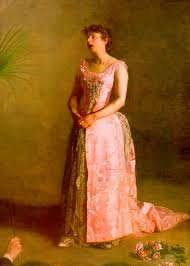
Romy Schneider, 23 September 1938 – 29 May 1982
I could spend years researching Romy Schneider.  But I don't have years - I have weeks.  There is less than a month to go before the premiere of the opera, and as we only got the score three weeks ago, I have lots of work to do!  When I'm not in rehearsals, or watching Romy Schneider films, or taking vitamins to help my hair grow out (we'll be getting "vintage" hairstyles in a few weeks and I've been told my hair needs to be longer), you will find me studying my score and listening to the helpful midi file which the composer has sent us.  Between the films, the music, and the staging rehearsals, I am just starting to get an idea of who Romy Schneider was...

Now, I mentioned that there are three of us playing Romy Schneider in the opera.  We have not been triple-cast in the same role.  Nor are we playing Romy at different ages.  We are all playing Romy at the same time.  Romy Schneider was a complicated woman full of contradictions.  And so we are each playing a different side of Romy's personality - Red Romy, Green Romy, and Yellow Romy.


The three Romys
We are a trio of sorts, and we often sing together.  But this is no anonymous ensemble like the Three Ladies.  Within the trio, we are very different personalities with very different fears and desires.  As our librettist explained to us, each colour represents a different aspect of Romy's life, and a different neurosis.  For Red Romy, the neurosis is attention.  Red Romy is obsessed with fame - with her relationship with her critics, the public, and the press.  For Green Romy, the neurosis is perfection.  Green Romy is the driven workaholic who always wants to be the best in her field.

For Yellow Romy - that's me - the neurosis is home and family.  Yellow Romy wants a marriage and children.  She wants a real home, where she can live a "normal" domestic life.  She is convinced that this is the only thing that will make her happy.  And when it doesn't make her happy, she can't face the truth that it isn't enough.

Fortunately - or perhaps, unfortunately? - pop culture is full of examples of women like this.  When I first encountered the idea of Yellow Romy, two TV characters immediately sprang to mind...

Betty Draper from Mad Men
...and Bree Van de Kamp from Desperate Housewives
These characters are something of an archetype.  They represent women who were raised to believe that the perfect domestic life - a husband, a home, and 2.5 children - is the only thing they should want, and that it should fulfill them entirely.  Inevitably, these women find that it isn't enough - maybe the marriage is dysfunctional, or maybe the kids are psychopaths, or maybe even when everything seems to be perfect it just feels empty.  But their real unhappiness is too difficult to bear, and so these women cover the truth with denial, pearl necklaces, and lots of valium.

Before I start launching into feminist theory though, let's get back to Romy Schneider.  As I've dug more into the role of Yellow Romy, I've discovered that she's more than just a desperate housewife.  She's an actress who's desperate for some stability in a very unstable life.  And that is something I can relate to very deeply.

I have been living abroad for almost four years now.  And while I'm glad to be following my passion and pursuing a career in opera, I often feel a bit lost at sea.  My family is in Canada, and even my boyfriend is miles away in Sweden.  My current flat isn't really my home - it's just a box that I'm inhabiting for the time being.  It feels blank and temporary.  I don't even have an oven or a microwave, or a real bed, or a stand-up shower. 

I have one of these.  For the record, it sucks.
I am always on the move, always figuring out what comes next.  It feels unstable, uncentred, insecure.  And while there's a part of me who is super-ambitious and determined to do whatever it takes to be an opera singer, there's another part of me that's very tired of all this upheaval.  A part of me who would love to settle down somewhere and start a family.  A part of me who looks with envy at other people my age who are "real grownups" with houses, husbands, cars, gardens, children - the works.

My boyfriend is lucky enough to live in a house in Gothenburg - a real house!  To him it's normal, but to me it's a huge luxury.  The last time I visited him he was completely mystified by my enthusiasm for staying in, baking bread, and cooking meals.  When he wanted to go out with friends, all I wanted to do was drink tea and watch television.  I know it must sound boring, but for me it was such an amazing novelty.  I don't have a home like that in Ghent, and it's something I miss a lot.

So I completely understand Yellow Romy's desperation to create a family and a home.  And I completely understand the conflict she feels between her ambitions as an actress and her yearnings for stability and domesticity.

Hmmm....
It's an amazing experience, being able to delve into a role and inhabit a character's world.  But it can also be overwhelming.

I have a lot of emotional content to explore as Yellow Romy, from the tense duet I sing with my husband about our dysfunctional marriage, to the ironically triumphant canon I sing about giving birth at the hospital while he stayed at home sleeping.  When I'm not being controlled by my husband or abused by my stepfather (Romy's stepfather allegedly took an "unhealthy interest" in her, and he probably sexually abused her), I'm being micromanaged by a fame-hungry stage mother (Romy's mother managed her career and often appeared in films with her when she was younger).  And as the more maternal of the three Romys, I am often sympathising with the others' suffering.  I absorb Green Romy's anxiety as she's bullied by a power-hungry director.  I absorb Red Romy's grief when Alain Delon leaves her.  It's a lot to take in.

This is why, walking home on Friday night after a run-through of Act 1, I found myself feeling extremely depressed.  I have experienced so many intense emotions this week as Romy Schneider.  It's exhausting.

Is it possible to get too much into character?  Can a role be dangerous for your mental health?  As a friend told me yesterday, the line between yourself and a character can at times be very thin.  But for reasons of self preservation, it's important to remember that the line is there.

And so, as I go into another week of being Romy Schneider, I'm doing my best to continue identifying with her.  But I'm also remembering the line, no matter how thin it is - for safety's sake.

Sunday, 21 April 2013

On believing in yourself...

I have always been a singer first and an actor second.  I started developing my musicianship and my singing technique long before I started to act on stage.  I took piano lessons and sang in choirs, and later on I began private voice lessons.  But I never took acting classes or joined a drama club.  In the course of my singing career, acting was something that just kind of happened to me.  It was like those parents that teach their kids to swim by throwing them into a pool.  At one point someone just plopped me on a stage and said "act".

I suppose some people would respond to this approach well.  They would act naturally, using their intuition.  But not me.  My response was more like this...

Uhhh... what?
I'm not the kind of person who listens to their intuition.  I like to learn things methodically.  I like to know exactly how I'm doing something, and why.  So when I was told to act, without any tools or method, without any guidance or technique, I got scared.  I didn't understand what to do.  I guess I saw that there was no one right answer and that kind of freaked me out.

As I continued my singing education, I never felt confident about my acting.  I thought some lucky people were just naturals at it, and I wasn't one of them.  People were always telling me that my acting was a weak spot.  And so I kept telling myself the same deadly words. 

"I can't."

These insidious words stayed with me all the time.  Eventually, they were what caused me to shy away from opera and pursue concert singing instead.  By singing in concerts, I could avoid the scary prospect of running around onstage, doing all kinds of crazy things and acting all kinds of crazy emotions.  I could essentially isolate my technique and musicianship and just be a "singing head".

Park and bark - sounds pretty good to me!
Eventually it dawned on me that nobody makes an entire career singing concerts anymore, and I began seriously pursuing opera.  But by this point it was too late.  I already had a firm idea fixed into my head: I can't act.  And so, even now that I am in an opera studio, this idea holds me back every day.

It's not that I don't try to act.  Of course I know it's something I have to do.  But I never do it with any amount of conviction.  I never take risks.  I never really go for it.  And it shows.  I'm always being told that I wasn't expressive enough, I didn't go far enough, I didn't make it big enough.  It frustrates me to no end.  I want so much to be that powerful actor that gives the audience goosebumps.  But what really happens is that I try just hard enough so that I can tell myself I'm trying.  I'm too afraid to really do it.  I'm too afraid to take the plunge.

Eek!
This week we did some sessions with a fantastic Belgian director, and he saw right through me.  He knew there was a step to be taken and I didn't dare to take it.  He asked me about my background, and I explained it to him.  I told him how I had worked in an office and sung in concerts, and I hadn't had much experience in opera.  I told him that acting was still very new to me.  I told him I wasn't a natural like some people were.  I told him that nobody had ever properly taught me how to act.

Basically, I told him a load of excuses.  And he dismissed them all.

This director told me a difficult truth.  A truth that's always been somewhere, tickling at the back of my mind.  A truth I've always brushed away, because I didn't want to believe it, because I couldn't bear facing it, because I couldn't stand thinking about what it implied.  The difficult truth is this: nobody can teach me to act.  It's just something that I do.  And either I do it or I don't.

In fact, the difference between acting and not acting lies in two very powerful words.

"I can".

President Obama's advice on acting.
The director told me it was very simple - either I go for it all the way, or I never dare and I never learn to act.  After this moment of truth, he asked me to sing Prince Orlovsky's aria, and to go as far with it as I could.

For those of you who don't know, Prince Orlovsky is the host of the big party in Die Fledermaus.  He's a very strange man, and a complete alcoholic.  In his aria, he explains that if his guests don't keep up with his drinking he will throw them out the door.  So basically I had to act drunk and aggressive, and make my imaginary guests feel as uncomfortable as possible.

I had a long table and some chairs to work with.  And as a starting point - this is just a starting point, mind you - the director told me to try prowling around on top of the table like a lion.

Prince Orlovsky meets the Lion King.
Normally I would freeze up in this situation.  I hate doing crazy things like this.  I always feel like I'm going to "do it wrong" and end up looking stupid.  But this time was different.  This time I told myself "I can".  I gave myself permission to act as stupid and weird and drunk as I could possibly imagine.

I prowled around like a lion on top of the table.  I swiped at imaginary guests with my paws.  I took off my shoes and threw them away.  I rolled around in a drunken stupor.

I stopped worrying about doing things right and lived in the moment.  And you know what?  It was pretty good fun.

In retrospect, I think it was the first time that I really acted.

Dr Strangelove, or How I Learned To Stop Worrying And Love The Stage.
All this time, I have been trying to act, but at the same time I've been saying to myself, "I can't".  I can't, I can't, I can't.  These may seem like only words, but they are actually extremely dangerous weapons.  If you say the words "I can't" to yourself enough times, the words turn into a belief.  As the belief strengthens, it turns into the type of action - or lack of action - which reinforces itself.  The more you tell yourself "I can't", the more true those words become.

The words you say to yourself are incredibly powerful.  They have a strong influence on how you think and act.  If you turn "I can't" into "I can", eventually you will start to think and act like someone who can.  But only you have the power to make this change.

When I gave up singing and went into arts administration, I remember that a small part of me hoped that someone would try to stop me.  A small part of me wanted someone to say "no, you are a really good singer and you can't give up".  But nobody did this for me.  Nobody told me I should keep pursuing singing.  That was something I had to figure out on my own.

When it comes down to it, there is only so much encouragement and motivation that you can expect from your friends, your teachers, and your mentors.  When it comes down to it, you have to be the ones who believes in yourself.  You have to be the one who says "I can".  Once you say that, and really believe it, you will be amazed by just how true it is.

Monday, 15 April 2013

On travelling...

If you read this blog you'll be aware that I travel pretty often.  Just yesterday I returned from a trip to Gothenburg, via a long bus trip through Oslo and Rygge (hey, it saved a lot of cash).  With all the jet-setting I've done over the past few years, I've been able to get a few things right - and a lot of things wrong.  Which is exactly why I feel qualified enough to share a bit of travelling wisdom with you.  Ladies and gentlemen, here are my very own Do's and Don't's of travelling cheaply through Europe...

DO plan your trip carefully.  Print out maps.  Look up timetables.  Make sure you have detailed directions.  Otherwise you might end up experiencing something like my Italian audition trip fiasco.

DO compare prices. Use price comparison sites such as www.skyskanner.com to find the cheapest flights - and if you're flexible with your schedule, you can also choose the cheapest days and times to travel.  A word about accommodation: if you aren't lucky enough to have a friend to stay with for free, find a cheap place to stay at a website like www.booking.com or www.laterooms.com.  My friend tells me that Ibis hotels are always good - they're clean, safe, inexpensive, and can be found everywhere.

DON'T stay overnight at the airport.  Unless it's completely unavoidable - and I mean completely unavoidable - just don't do it.  Yes, it may seem smart to save money by sleeping rough and catching that cheap flight that leaves at evil o'clock in the morning.  But trust me, the sleepless night curled up on the airport bench is NOT worth the difference in price.  Especially if you're at London Stansted - or, as it's better known, Purgatory.

DO pack lightly.  Ok, so I haven't always been great at this, as friends and family will attest...

Simulation.  Not writer's actual suitcase.
But after being on several flights with strict carry-on weight limits, I have learned to hone down to the essentials.  One pair of smart shoes in the suitcase, one comfy pair worn on the plane.  Makeup bag, phone charger, toothbrush, and a couple of outfits - that's all you need.  Remember: unless you are travelling to the wilds of the Saharan desert, you will probably be able to do laundry.

DON'T assume buses and trains always run on the same schedule.  Travelling on a Sunday is a dangerous thing, as I discovered yesterday.  Buses that usually come every ten minutes suddenly get very lazy.  They may decide instead to only come every thirty minutes, or every hour, or two or three times in the day on a random whim.  Be prepared for lazy Sunday buses!

DO invest in the future.  Think ahead.  Will you be taking this same bus back to the airport?  Then get a return ticket.  If you'll be using a bus/train/tram/rickshaw regularly on this trip, think about getting something like a ten-ride ticket or a weekly or monthly pass.  It may seem not seem like much, but all those single ride tickets add up to a lot of extra money you don't need to spend.

DO stay hydrated. Planes are extremely dry, and it's easy to get dehydrated or even get sick if you don't drink lots of water. Yes, it might be embarrassing to be that guy who's always asking his neighbour to get up so he can squeeze past and go to the toilet. But trust me, it's worth it to not feel like this the next day...

Evian, why have you forsaken me??!
DON'T be a sheep.  I can't believe how many times I've seen people rush to line up for boarding just because they saw one guy stand up. 

Baa.
And then they end up standing there for ages while nothing happens.  Why, why, WHY??  What are you actually achieving by lining up like that??  If you have an assigned seat, you will be sitting there whether you board the plane first or last.  If you don't have an assigned seat, get this - being the last to board is actually not the end of the world!  In fact, it probably means you will get an aisle seat, which means you can get up for the toilet as much as you want without bothering your neighbours (see hydration, above).

DO be smart about money.  Did you know Norwegian coins have holes in the middle of them?

They're like fancy metal Norwegian doughnuts.
That's pretty cool.  It's also cool to know that you'll need to carry cash in Norway - whereas in Sweden and Denmark you can pay for virtually anything with a debit card.  It's always good to know how money works wherever you're going, and to be prepared accordingly.

DO try to eat well.  Yes, it can be hard to find proper food at airports and train stations.  But if you eat real meals you'll be less likely to waste money filling up on crisps and chocolate.

Well, ok... maybe you can still have a bit of chocolate...
DON'T let your temper get away with you.  Here's a little story for you.  The last time I flew to Canada, I had an early morning and was feeling very tired and grumpy.  And to make matters worse, the person behind me kept punching the back of my headrest.  As I sat there fuming, and the punching continued, I built up a very clear image in my head of this obnoxious headrest puncher.  It must be a teenage boy, drunk or possible stoned.  He would be wearing some kind of sports jersey and baggy jeans.  And he was sitting there with his friend, laughing at me, punching my headrest, knowing I was too polite to confront him about it.  After several hours of torment, my anger and resentment towards this headrest puncher grew to such an extent that I finally exploded.  I whipped my head around in rage -

Not a simulation.  Writer's actual face.
- only to discover a meek and apologetic older woman cowering behind me.  She was not in fact punching the back of my headrest on purpose, as my sleep-deprived, travel-enraged mind had led me to believe.  She was just trying to turn up the volume of her movie on a rather unresponsive touch screen.  The lesson?  It's easy with all the stress of travel to get extremely irrational and angry.  So when you feel your temper getting the best of you, take a deep breath and count to ten.  Things are probably not as terrible as you think they are.

DO bring something to fight the boredom.  Whether it's a book or a magazine or the latest season of your favourite show - just make sure you keep it light and fluffy.  This is not the time to try to read War and Peace.  You will be stressed out, sleep deprived, and distracted by boarding announcements.  Basically, you should prepare to have about half of your usual IQ.

DO plan for recovery time.  Travelling is tiring, especially if you're crossing time zones.  And in my experience, jetlag only gets worse as you get older.  I recently made the mistake of scheduling a singing lesson just two days after arriving on a cross-atlantic flight.  I was still exhausted and jet-lagged, and I was completely useless in the lesson.  Know your limits and give yourself time to rest after a trip.  You'll need some time to be useless before you can be useful again.

DO bring a notebook.  Sometimes I get my best ideas when I'm travelling.  I zone out, look out the window at the scenery, and BOOM - I get a Eureka moment.  Maybe this is just me being an introvert, but I think the best thing about long trips is it can give you time to think.  So make sure you have somewhere to record your ideas and insights.

These are the most helpful tips I can think of now, although I'm sure that more will come to me the next time I'm travelling,  For now I'll leave you with one more tip: once you've booked the flight, printed the maps, and packed your bags - have fun!  After all, travelling is only worth all this stress if you get an adventure out of it.  So wherever you are in the world, take some time to enjoy the experience!

Tuesday, 9 April 2013

On being far away...

This year for Christmas, my boyfriend gave me a wallet.  Perhaps it doesn't sound to you like the most romantic gift in the world, but I love it.  Not just because it's made by a label called "Puccini".  And not just because it has lots of little compartments that help me organise my various foreign currencies and bank cards.  I love the wallet because I use it all the time, and every time I use it, I think of him.  I don't know about you but I think that's pretty romantic.

Every day I feel lucky to be where I am, to be following my dreams.  But every day I also deal with the fact that I am far away from the people I love.  Even now, when I am visiting my boyfriend in Sweden, I am far away from my family in Canada.  People often ask me if I miss Canada.  To be honest, I don't often miss Canada.  But I always miss my family.

I consider myself very lucky to have been born into such a large and loving family.  My family is full of character, curiosity, and passion.  Many of us are musical, and most of us are avid readers.  And although we don't always agree on everything, most of the time we get on very well.  We love to gather, usually over loads of food, and talk each other's ears off.  I love my family and I love spending time with them.  This is a part of my life that I miss very much now that I'm living abroad.

I also miss my boyfriend, who understands me in a way most people don't, and who always knows how to make me laugh.  When we were living in Glasgow I knew he was the right guy because I felt at home when I was with him.  Now that we live in different countries, he's still my home away from home - but he's no longer a 20 minute bus ride away.

Despite their absence, I have found many ways to surround myself with the people I love.  Of course, like anyone living abroad I stay in touch with my family over email and skype.  Obviously I can't stay in touch with everyone this way (there are a LOT of us), but I find that facebook is another great way to keep track of people.  I'm always grateful for the regular updaters in the family, who post pictures and videos and status updates, keeping me up to speed on my nieces and nephews' latest escapades, my cousins' latest projects, or my brothers' latest concerts.  But while the internet is a wonderful thing, the most beloved connections I keep with my family are the tangible ones.

I have a collection of keepsakes scattered around my flat.  There are the photos from my brother's wedding, and the homemade keychain and pencil case from my niece.  There are cards and letters from my boyfriend, and a photo of him which his mother framed for me.  There's a crystal hanging by my window which turns the sunlight into rainbows - a beautiful gift from my parents.  There are letters and postcards from friends and family, and countless trinkets and souvenirs from all the places I've been.

But my all-time favourite keepsake is a sign that says in colourful bubble letters "Welcome home Brynne".  It's from a difficult Christmas a couple of years ago, when I came home a complete mess.  I had just been dumped.  I had also been rejected several times in a run of unsuccessful auditions.  I had lost all my confidence and conviction.  And when I arrived home from the airport, feeling heartbroken and downtrodden, this cheerful sign was stuck on the door.  Waiting for me.  Welcoming me.  Letting me know that no matter what happened, my home and my family were always there.

I now put that sign up on my door -  that is, the door of wherever I'm living at the moment.  It's a reminder that I am home no matter where I am.  I am home because I am always surrounded by the unconditional love and support of my family.

This weekend was my grandma's memorial, an event that I was sadly unable to attend.  But while the prices of plane tickets kept me from crossing the Atlantic, I found other ways to be with my family at this time.  My mom has been sending me regular email updates these last few months, from the time Grandma went into the hospital, to when she went into palliative care, to her final hours.  So I had some time to prepare for her passing, and to think about how I could send my love in a tangible way.  I knew how much my keepsakes from the family meant to me, and I wanted to be able to send something similar to my family.

Naturally, if I was there, I would be singing at the memorial service.  I always sing at family weddings and funerals.  And it would mean a lot for my grandma because she was a singer too.  I decided that the best way to send my love was to record one of my grandma's favourite hymns and send it to my parents so it could be played in the service.

I wasn't able to be at my grandma's memorial, or at the big family gathering that surrounded it.  But I was able to read the text of my dad's eulogy, and to see pictures of my nephews emailed through my mom's BlackBerry.  I was able to skype with the family, getting passed around the sitting room on my brother's iphone.  I even "met" my new baby nephew for the first time (we had a fascinating conversation involving lots of squeals and flailing arms).  My uncle made a video of the service for myself and other absent family members, and I look forward to watching it and "being there" in my own way.

It's not the same as really being there, of course.  And I still get pangs of guilt about that sometimes.  But that's just the way it is right now.

The saddest part of going on an adventure is the people you leave behind.  Every birthday, every anniversary, every wedding and funeral that you miss - it stings.  But real love is more than a physical presence.  It's something that can cross borders and oceans, that can be felt from far away.  I feel the love and support from my family every day.  And I hope they feel it too.

These keepsakes I treasure so much, they aren't important in themselves.  They're important because they remind me of something that's already there.  Every day, no matter where I am and no matter what I am doing, I am surrounded by love.  And my boyfriend and my family are surrounded by it too.  We can't always be there for each other physically.  But we are always there for each other in spirit.

Monday, 1 April 2013

On staying strong...

Some singers I know have a certain hardness to them, a certain toughness.  They are extremely focused and ambitious and they don't seem to let anything get in their way.  If something bad happens, it doesn't phase them - they just keep going.  They are bulletproof.  Unstoppable.

I am not one of those singers.

I'm not hard or tough.  In fact, I'm really very soft.

I keep thinking that with time, with more rejections and challenges, I will grow a thicker skin.  But after years of hard falls and disappointment, the fact remains that I can cry at the drop of a hat.  And I often do.

"Oh my God!  That man - just - dropped his hat!"

Maybe it's something unchangeable about me, an intrinsic part of my nature.  Like my terrible sense of direction (despite all the travelling I've done, I still get lost ALL THE TIME).  I don't know.  But I really wish I was tougher than I am.  After all, the singing business is a school of hard knocks.  We have to face rejection and harsh criticism all the time.  Surely toughness is a quality you need in order to survive in the music world.

I was chatting about this recently with a visiting teacher at the studio, and lamenting my lack of toughness.  I mentioned certain successful singers I know who have this bulletproof quality to them, and expounded on how much I wished I had their hardness.  "But," he said quite reasonably, "you don't.  That's not who you are.  You need to embrace who you are and learn to work with it."

Sounds like pretty sensible advice, right?  But I wasn't so sure.  How can my softness be a good thing?  How can I "work with" the fact that I'm so easily reduced to tears by criticism and negative feedback?

How is it positive that I'm so easily wounded?  That instead of walking through life like this...

I'm essentially walking through life like this...?


It's been an emotional couple of weeks.  I've had an important audition, a recording, and a recital, and I've been putting a lot of pressure on myself to perform well in all three.  On top of this, my grandmother passed away recently and I'm probably the only person in the family who won't be able to attend the memorial.  And as luck would have it, I haven't been feeling well.  I tend to get pretty weepy when I'm not feeling well.

The first breaking point came when we did audition training with a visiting director.  I saw this audition training as a practice run for my audition the following week, and I was anxious to sing well.

I did not sing well.  And the director didn't pull any punches in his criticism.  He was very harsh.

Maybe he wasn't that harsh.  Maybe I was too sensitive, and I took it too personally.  In any case, I cried.  A lot.

Then there was the audition itself.  I was so anxious to do well in this audition that I think I may have made myself sick.  Stress, tension, and sleepless nights led to a bout of tonsilitis.  Which led to antibiotics.  Which made me sick to my stomach.  When I arrived at the audition I was exhausted and nauseous, and although I gave it all I had, I probably wasn't at my best.

After all that anxiety and preparation, I didn't get the callback.

I was heartbroken.  Of course I had tried not to get my hopes up too much.  But I had really wanted this, I had really thought I had a good chance.  The rejection was a huge disappointment and a major blow to my confidence.


Ouch.
I cried.  I drank beer.  I cried some more.  I talked to friends.  I cried some more.  Basically, I stayed up all night being sad.  It was not fun.

At times like this, when it really gets to me, I can't help but wonder if maybe I don't have what it takes.  If I'm not tough enough to roll with the punches.  Not cut out for this school of hard knocks.

But you know what?  In each of these instances, after I mourned the disappointment, I moved on.  After the audition training, I spent some time sniffling in the washroom.  But then I wiped away my tears, ate my lunch, and ended up having two very good coaching sessions.  After feeling heartbroken about the unsuccessful audition, I had a terrible beer-soaked sleepless night.  But the next morning I got on my computer and started looking for more auditions.

It is possible to be sensitive and resilient.  To keep going when you're hurt.  You can be soft and strong at the same time.

These qualities are not just for toilet roll.
Look, it sucks to be the one who cries all the time.  It's embarrassing.  I would love to be made of steel and never show emotion.  But that's not who I am.  I'm soft.  I'm vulnerable.  I feel things deeply.  Do I care too much?  Perhaps.  But perhaps that's not entirely a bad thing.

Singers are emotional creatures by nature.  We sing all the time about love and hate, hope and despair, misery and joy - the biggest, most powerful human emotions.  We need to feel things deeply so we can channel it into our singing.  We are all emotional people.  The difference lies in how we handle our emotions.

Personally, I wear my heart on my sleeve.  Sometimes it's a helpful quality to have.  It means that I'm sensitive and open, and people can see that I care deeply about things.  Other times it works against me, and I get overwhelmed by my feelings.  But I have learned that the best way to deal with this is not to repress or hide my feelings.  I need to feel them to their full extent, exorcise them if you will - and then move on.

Hopefully, when I exorcise my feelings, they don't look quite this bad.
Over the years I've found some good outlets for my feelings.  Sometimes I need to sing.  Sometimes I need to blow off some steam by going for a run.  Sometimes I need to calm down with some yoga or a hot bath.  Sometimes I need to have a drink and vent to a friend.  And sometimes I need to write in my blog.  These are all things that help me stay sane and work through my emotions in a constructive way.

It's not easy being sensitive, but beating myself up about it will only make matters worse.  It's better to accept that it's the way I work, and learn how to cope with it.  It might be embarrassing when people hear me blubbering in the next toilet stall.  It might seem that I'm "falling apart", or losing control.  But does it really matter how much I react?  Does it really matter, when in the end I'm still able to pick myself up and carry on?

There's more than one way to survive getting hit.  You can protect yourself by being hard and unyielding.  Or you can be a rubber ball.

Huh?
Rubber is soft.  When it hits a hard surface, it changes shape.  It absorbs the pressure.  But then it bounces back.

Right now, I am learning to be a rubber ball.  To work with my softness, and to let it help me bounce back.  I may be easily hurt.  But that doesn't mean I can't easily recover.